Utilice laminación integrada sin adhesivo de TPU/ABS para láminas automotrices de alto volumen cuando la estructura sea estable y la eliminación de un paso separado de recubrimiento, curado y laminación ofrezca un claro beneficio en términos de costos o control de emisiones. Utilice laminación adhesiva cuando los cambios frecuentes de película, las superficies decoradas o las combinaciones de materiales complejas requieran una mayor flexibilidad de unión.
Ninguna de las dos opciones es automáticamente superior. Apruebe el proceso solo después de probar el TPU, el ABS, la capa de unión o el adhesivo exactos mediante termoformado, pelado, envejecimiento, COV, empañamiento y requisitos de apariencia.
¿Qué significa laminación en molde en este contexto?
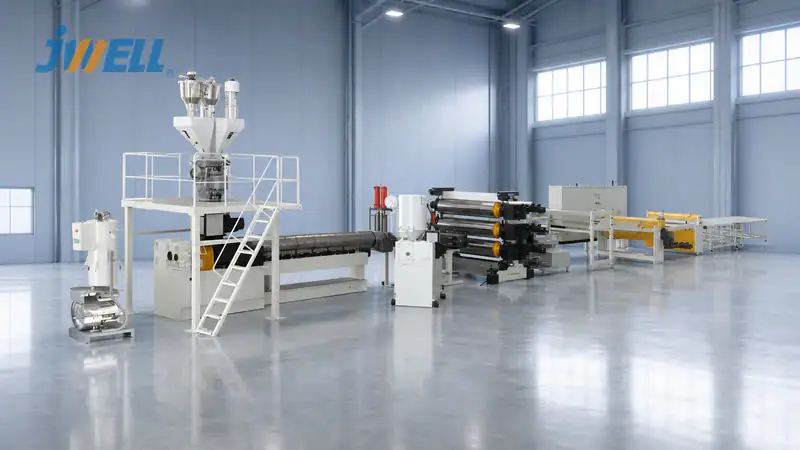
El término laminación en molde puede resultar ambiguo. En este artículo, se refiere al proceso integrado y sin adhesivos de JWELL para producir una capa superficial de TPU sobre una lámina automotriz a base de ABS. No se refiere a la inserción de una película decorativa en un molde de inyección.
Según el diseño de la línea, las capas pueden combinarse en la matriz o en una sección de laminación y conformado posterior controlada. Es necesario confirmar el método exacto de fusión y unión para el equipo propuesto. Entre las descripciones más comunes se incluyen la laminación integrada de TPU/ABS, la laminación en línea, la laminación por coextrusión y la laminación sin adhesivos.
Cómo funciona la laminación integrada de TPU/ABS
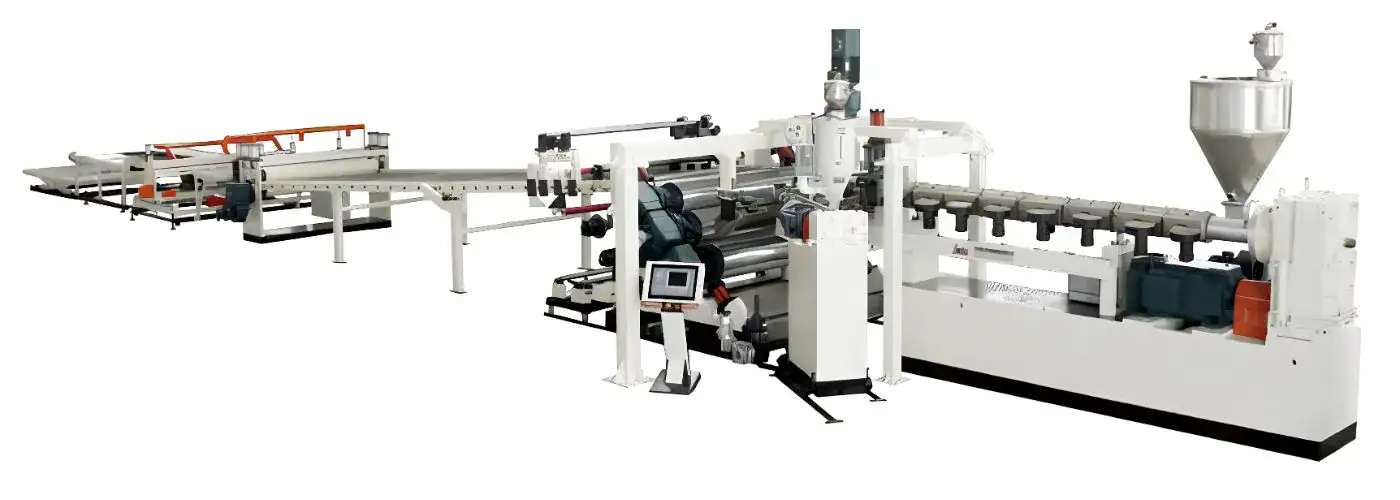
El ABS y el TPU se plastifican en extrusoras independientes, diseñadas específicamente para cada material. Sus caudales, temperaturas y proporción de capas se coordinan antes de que el compuesto pase por los procesos de calibración, enfriamiento y corte. La alimentación gravimétrica, el control de la presión de fusión y la medición automática del espesor mejoran la uniformidad.
Este método elimina la necesidad de preparación del adhesivo, recubrimiento, evaporación del disolvente, curado y una pasada de laminación adicional. Además, reduce la manipulación de los rodillos intermedios. Sin embargo, ambos flujos de material fundido deben permanecer estables simultáneamente. Cualquier alteración en el secado, la presión, la temperatura o el caudal en cualquiera de los lados afecta a la lámina completa.
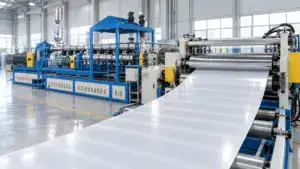
La línea de extrusión de placas compuestas para interiores de automóviles JWELL TPU está diseñada para la producción integrada de láminas de TPU/ABS sin adhesivos.
Cómo funciona la laminación adhesiva
La laminación adhesiva une una película de TPU terminada a una lámina de ABS mediante un adhesivo líquido, termofusible, reactivo o en película. Las superficies pueden requerir limpieza, tratamiento con corona, plasma o llama, o imprimación. Un proceso de unión controlada fija las capas, seguido de enfriamiento, secado o curado.
Este enfoque separa la fabricación de la película, la extrusión de la lámina y el pegado. Si bien añade operaciones, permite al convertidor adquirir películas especiales, cambiar colores o texturas y seleccionar un adhesivo desarrollado para una interfaz compleja.
Las variables clave del proceso incluyen el peso del recubrimiento, la proporción de mezcla para sistemas multicomponentes, el tiempo de vida útil, la energía superficial, el secado, los volátiles residuales, el tiempo de curado y el almacenamiento. El adhesivo sin disolventes aún requiere dosificación y control del curado; no debe considerarse una opción sin proceso.
Estructuras típicas de capas de TPU/ABS
Las siguientes construcciones son meramente ilustrativas. La arquitectura final depende de las calificaciones, los objetivos estéticos y los resultados de la validación.
| Estructura | Ventaja principal | Riesgo principal |
|---|---|---|
| TPU / ABS | Menos capas y sin adhesivo | La compatibilidad directa puede ser insuficiente |
| TPU / capa de unión / ABS | Ventana de unión más amplia | Material adicional y control de la proporción de capas |
| Película de TPU / adhesivo / ABS | Selección de películas flexibles y adhesivos | Controles de recubrimiento, curado y emisiones |
| Película de TPU decorada / adhesivo / ABS | Gran libertad de diseño | Formación del registro y durabilidad de la interfaz |
No asuma que todos los tipos de TPU y ABS se adhieren directamente. El TPU de poliéster y poliéter, la dureza, los aditivos, la composición del ABS y la contaminación superficial pueden alterar la interfaz. Puede ser necesario un tipo compatible o una capa de unión.
Resistencia de la unión y modo de fallo
La laminación integrada une los materiales permitiendo que sus superficies entren en contacto íntimo y, cuando los materiales son compatibles, se produzca difusión interfacial o interacción química. La laminación adhesiva utiliza un material independiente diseñado para humedecer y conectar ambas superficies.
La resistencia inicial al despegue no es suficiente. Pruebe después de:
- Envejecimiento por calor y humedad
- Ciclos térmicos
- Exposición a los rayos UV cuando corresponda
- Contacto con productos de limpieza, protectores solares u otros productos químicos de interior.
- Termoformado y recuperación dimensional
- Almacenamiento y manipulación representativos de la producción
Registre el modo de falla y la fuerza. El desprendimiento interfacial, la falla del adhesivo cohesivo, el desgarro del TPU y la falla del sustrato de ABS indican diferentes debilidades. Los criterios de aceptación deben reflejar las especificaciones del componente y del fabricante, no un valor de desprendimiento universal.
COV, olores y nebulización
Eliminar el adhesivo puede eliminar una posible fuente de disolvente, monómero residual, subproductos de reacción y olor. Además, puede simplificar la lista de materiales y reducir la manipulación de productos químicos.
La laminación de interiores automotrices sin adhesivos no garantiza automáticamente la ausencia total de COV (compuestos orgánicos volátiles). El TPU, el ABS, el concentrado de color, los auxiliares de procesamiento, los agentes de limpieza y la degradación térmica pueden contribuir a la aparición de olores, COV o empañamiento. Utilice el método de prueba, la preparación de muestras y el acondicionamiento especificados por el cliente.
La laminación adhesiva también puede cumplir con requisitos estrictos si el adhesivo, el espesor de la capa, el secado y el curado están debidamente cualificados. Evite afirmaciones categóricas como cero emisiones o ausencia de sustancias nocivas a menos que estén respaldadas por pruebas realizadas al laminado completo.
Rendimiento de termoformado
Las láminas compuestas para automoción se suelen recalentar y moldear para fabricar salpicaderos, paneles de puertas u otras piezas interiores. El TPU y el ABS presentan comportamientos diferentes de ablandamiento, estiramiento y contracción. La interfaz debe permanecer intacta durante el calentamiento, el embutido profundo y el enfriamiento.
Una estructura integrada puede proporcionar una fina capa de TPU sin adhesivo, que podría ablandarse o transparentarse. Un adhesivo puede soportar la tensión, pero debe tolerar la temperatura de moldeo y la elongación. En ambos casos, puede producirse deslaminación, blanqueamiento, efecto piel de naranja, cambios de brillo, pérdida de grano o adelgazamiento localizado.
Realice pruebas con la herramienta de producción o una geometría representativa. Mida el espesor total y el espesor de la capa de TPU en las zonas de embutición profunda. Inspeccione los radios, las esquinas y los bordes recortados después del conformado y el envejecimiento.
Control de procesos y flexibilidad de producción
La producción integrada requiere un secado de resina coordinado, temperaturas de fusión, caudal de la extrusora, presiones, relación de capas, temperatura del rodillo, ajustes de presión o calibración y refrigeración. Los residuos iniciales contienen polímeros mixtos y pueden ser difíciles de reutilizar.
La producción de adhesivos implica inventario, manipulación y trabajo en curso, pero la película de TPU y la lámina de ABS se pueden fabricar e inspeccionar por separado. Esto resulta útil para volúmenes bajos y cambios frecuentes de apariencia. Los controles adicionales pueden incluir pruebas de energía superficial, verificación de la mezcla adhesiva, medición del peso del recubrimiento, registros de secado o curado y pruebas de disolvente residual.
Compare el costo por metro cuadrado aceptado.
No compare únicamente los precios de la resina y el adhesivo. Incluya:
- Consumo de TPU, ABS, capa de unión y adhesivo
- Energía de secado, extrusión, recubrimiento y curado
- Residuos de puesta en marcha, recorte de bordes y cambio de formato
- Manejo de mano de obra y productos en proceso
- Tratamiento de superficies y controles de emisiones
- Inspección, pruebas y retrabajo
- Tiempo de inactividad, limpieza y cambio de grado
- Rendimiento después del termoformado
La laminación integrada suele ser más resistente a grandes volúmenes con una estructura de capas estable. La laminación adhesiva puede resultar más económica cuando las variaciones frecuentes generarían, de otro modo, un gran desperdicio y residuos iniciales.
Matriz de selección
| Requisito | Ruta integrada sin adhesivos | Laminación adhesiva |
|---|---|---|
| Construcción estable de gran volumen | Ajuste fuerte | Adecuado |
| Eliminar la operación adhesiva | Ventaja clave | No |
| Cambios frecuentes en la película o el diseño | Más configuración y purga | Fuerte flexibilidad |
| Interfaz de material difícil | Puede requerir una capa de unión o de grado compatible. | El adhesivo puede unir la interfaz |
| Película decorada especial | Debe ser compatible con la línea | A menudo ventajoso |
| Recuento mínimo de fuentes de COV | Ventaja potencial | Depende del adhesivo y del curado. |
| Inspección por separado de la película y la hoja. | Limitada | Fuerte ventaja |
Preguntas frecuentes
¿La laminación de TPU/ABS sin adhesivos garantiza un bajo nivel de COV?
No. Se descarta el adhesivo como una posible fuente, pero el sistema de materiales completo y las condiciones de procesamiento aún deben pasar la prueba especificada.
¿Se puede laminar cualquier tipo de TPU directamente sobre ABS?
No. La compatibilidad varía según la composición química del TPU, su dureza, los aditivos y el tipo de ABS. Pruebe la unión directa y la opción de capa de unión antes de finalizar la línea.
¿Qué proceso es mejor para una amplia gama de colores y texturas?
La laminación adhesiva suele ofrecer mayor flexibilidad cuando las películas especiales se adquieren por separado. La producción integrada aún puede admitir variantes, pero las pérdidas por cambio de producto deben incluirse en el modelo de costos.
Seleccione la ruta con pruebas a nivel de tramo
Elija la laminación integrada de TPU/ABS para interiores de automóviles cuando la combinación de materiales sea estable, el volumen de producción sea alto y la estructura sin adhesivos cumpla con todos los requisitos de unión y conformado. Elija la laminación adhesiva cuando la variedad de películas y la flexibilidad de la interfaz justifiquen el proceso adicional.
Revise los equipos de JWELL para la industria automotriz que utilizan materiales nuevos o comuníquese con JWELL para proporcionar información sobre los grados de TPU y ABS, la estructura de capas propuesta, el espesor, el ancho, la producción, las especificaciones de la superficie, la profundidad de conformado y la lista de pruebas del fabricante de equipos originales (OEM). Estos detalles son necesarios para definir las extrusoras, el método de unión, el control del espesor y el plan de pruebas.