La ligne d'extrusion contrôle l'épaisseur, la qualité de surface, la résistance de l'adhérence, la stabilité de la production et l'homogénéité du produit final . Le TPU est apprécié pour son élasticité, sa résistance à l'abrasion et aux produits chimiques, ainsi que pour sa large gamme de dureté . Il est utilisé dans les secteurs de l'automobile, du médical, de la chaussure, du textile, de l'emballage et dans de nombreuses applications industrielles. Cependant, le TPU est également un matériau très sensible à la température, à l'humidité, à la conception de la vis d'extrusion et aux paramètres de production en aval.
Fonctionnement d'une ligne d'extrusion de TPU
Une ligne d'extrusion de TPU est un système continu. La matière première entre d'un côté et un film, une feuille ou un produit intermédiaire fini sort de l'autre. La qualité du résultat dépend de la fluidité du fonctionnement de chaque section avec la suivante.
Alimentation et fusion du matériau TPU
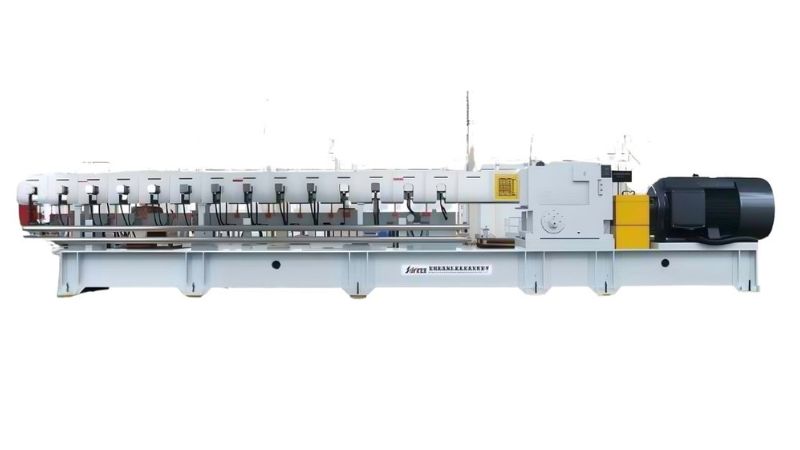
Le processus commence par l'introduction de la résine TPU dans l'extrudeuse. Dans de nombreux systèmes TPU, notamment pour le compoundage ou l'extrusion par réaction, on utilise souvent des extrudeuses à double vis car elles permettent un meilleur contrôle du mélange, de la température et du débit de matière.
À l'intérieur du cylindre, le matériau est chauffé et cisaillé jusqu'à l'obtention d'une fusion stable. Dans l'extrusion-réaction du TPU, le processus peut aller encore plus loin.
Façonnage, moulage et formage en ligne
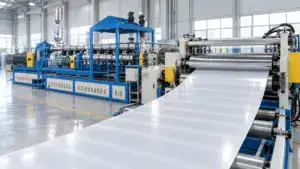
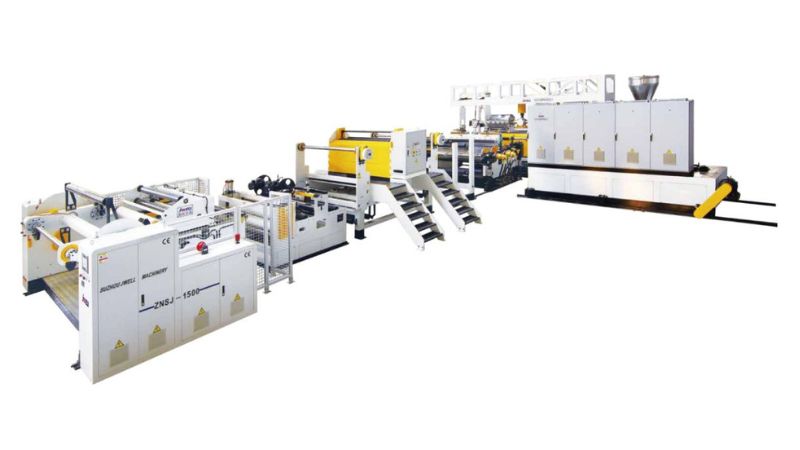
Après fusion, le TPU s'écoule à travers la filière et passe dans la section de mise en forme. Pour la production de films TPU, Jwell met en avant le procédé de compoundage par coulée en bande en une seule étape et le formage en ligne simple ou double face comme des avantages majeurs par rapport au compoundage traditionnel hors ligne en plusieurs étapes.
C'est important car chaque étape supprimée peut vous aider :
- réduire la manutention
- coût de production inférieur
- améliorer l'efficacité de la production
- améliorer les performances de liaison
- réduire la variation entre les lots
En résumé, plus votre ligne de production est stable et continue, plus la qualité de vos produits devient prévisible.
Contrôle du refroidissement, de l'enroulement et de la puissance finale
Une fois le TPU formé, il doit être refroidi et manipulé correctement. Cette étape est facile à négliger, mais elle a un impact direct sur :
- platitude
- qualité du rouleau
- stress interne
- consistance d'épaisseur
- aspect superficiel
Quels sont les facteurs qui affectent la qualité de production du TPU ?
Pour obtenir une meilleure qualité de TPU, il faut prendre en compte d'autres facteurs que la vitesse de la ligne. Le TPU est sensible aux variations de processus ; sa qualité dépend donc généralement de plusieurs facteurs interdépendants.
Le contrôle de l'humidité avant tout
Le TPU est très sensible à l'humidité lors de sa transformation. Si le matériau n'est pas correctement séché avant l'extrusion, vous risquez d'observer les problèmes suivants :
- produit des bulles
- défauts de surface
- propriétés mécaniques faibles
- comportement de fusion instable
Il s'agit d'un des points de contrôle les plus importants dans l'extrusion du TPU. Même une vis robuste et une filière de qualité ne peuvent compenser entièrement la mauvaise qualité de la matière première. Pour obtenir une production stable, il faut d'abord une matière première stable.
Le contrôle de la température doit rester équilibré.
Le TPU nécessite un contrôle précis de la température. Une température insuffisante peut entraîner une fusion irrégulière, tandis qu'une température excessive peut endommager le matériau et nuire à son aspect ou à ses performances. Les recommandations techniques relatives à l'extrusion du TPU insistent sur la nécessité d' un contrôle précis de la température, de la pression et du débit de matière afin d'obtenir une qualité de produit constante.
Vous devez prêter une attention particulière à :
- profil de température du canon
- température de la matrice
- température de fusion
- vitesse de refroidissement
Ces réglages doivent être compatibles. Si une zone est trop chaude ou trop froide, la stabilisation de l'ensemble de la ligne peut devenir plus difficile.
La conception de la vis et le temps de séjour sont importants.
Toutes les vis ne sont pas adaptées au TPU. Les recommandations du fabricant indiquent spécifiquement que le traitement du TPU bénéficie de conceptions de vis telles que : vis de barrière ou vis de mélange pour améliorer la qualité de la fusion et du mélange. Les systèmes d'extrusion par réaction de Jwell liés au TPU mettent également l'accent sur géométrie de vis optimisée, rapport L/D élevé et conception de vis autonettoyante pour favoriser l'efficacité des réactions, réduire l'accumulation et maintenir une qualité stable.
Pour vous, cela signifie que la conception des vis a une incidence sur :
- homogénéité de la fusion
- dispersion additive
- stabilité de la pression
- cohérence des résultats
- risque de dégradation
Une ligne peut avoir une puissance moteur élevée, mais si la vis n'est pas conçue pour le TPU, la qualité de votre sortie risque d'être médiocre.
L'automatisation des lignes favorise la répétabilité
La production de TPU gagne en stabilité lorsque votre ligne réduit les variations manuelles. La ligne de film TPU de Jwell favorise l'automatisation à haute vitesse , le contrôle en ligne de l'épaisseur et l'enroulement automatique , contribuant ainsi à une production stable.
Ceci est particulièrement utile pour la production de films haut de gamme ou de structures multicouches. L'automatisation permet de maintenir le processus au plus près de la cible et de réagir plus rapidement aux changements de conditions.
Comment améliorer simultanément la qualité et la production
De nombreux fabricants pensent devoir choisir entre une production accrue et une meilleure qualité . Dans le domaine de l'extrusion TPU, ce n'est pas toujours le cas. Avec une ligne bien conçue, il est possible d'améliorer simultanément les deux.
Associez la ligne au type de produit
Le TPU est utilisé sous de nombreuses formes, notamment pour le moulage de films composites , les films thermofusibles , les films à haute élasticité et les films invisibles pour revêtements automobiles . Chaque type de produit impose des exigences différentes à la ligne de production.
Voici une comparaison pratique :
| Focus produit | Ce dont votre ligne a le plus besoin | Pourquoi ça compte |
| Film TPU mince | Contrôle précis de la matrice et de l'épaisseur | De petites variations d'épaisseur deviennent rapidement visibles. |
| Film composite | Lien en ligne stable | Une mauvaise adhérence diminue la valeur du produit |
| Film TPU à haute élasticité | Bonne uniformité de fusion | Une fusion irrégulière réduit la consistance mécanique |
| film de surface de qualité supérieure | Procédé propre et enroulement stable | Les marques en surface peuvent entraîner un rejet |
Utilisez une liste de contrôle de processus simple
Si la qualité de la sortie diminue, vérifiez la ligne dans l'ordre :
| Check Point | Ce que vous devriez rechercher | Risque commun |
| Matière première | Séchage et consistance de la formulation | défauts d'humidité |
| extrudeuse | Adaptabilité de la vis et alimentation stable | mauvaise fusion ou surtension |
| Profil de température | Équilibrage du canon et de la matrice | Surchauffe ou fusion incomplète |
| Section de formation | jeu de matrice et stabilité de la coulée | Variation d'épaisseur |
| Refroidissement et bobinage | La tension et le roulement s'accumulent | Problèmes de surface et distorsion |
Réfléchissez en termes de stabilité du système
Votre ligne de production de TPU fonctionne de manière optimale lorsque chaque étape soutient la suivante. Une bonne extrudeuse ne suffit pas. Une bonne filière ne suffit pas non plus. Une production stable de TPU repose sur un système cohérent qui combine :
- conception de vis appropriée
- alimentation précise
- historique de chaleur contrôlée
- formation stable
- gestion fiable en aval
Collaborez avec Jwell pour une solution d'extrusion TPU haute performance
Pour obtenir une production de TPU de haute qualité, il est essentiel de privilégier une fusion stable, un formage précis et un contrôle rigoureux des étapes suivantes . La combinaison de ces éléments garantit à votre ligne de production productivité et qualité optimales.
Chez Jwell , nous pouvons concevoir une solution d'extrusion TPU adaptée à vos objectifs de production, que vous fabriquiez des films TPU, des structures composites, des films thermofusibles ou d'autres produits flexibles à haute valeur ajoutée . Contactez-nous pour discuter d'un système adapté à vos matériaux, à votre production cible et à vos exigences de qualité.
Questions fréquemment posées
Qu'est-ce qu'une ligne d'extrusion de TPU ?
Une ligne d'extrusion de TPU est un système de production qui fait fondre le TPU, le pousse à travers une filière, le façonne en film, en feuille ou sous une autre forme, puis le refroidit et l'enroule ou le découpe.
Pourquoi le TPU est-il plus difficile à transformer que certains autres plastiques ?
Le TPU est sensible à l'humidité, à la température et aux contraintes de cisaillement . Un mauvais contrôle de ces paramètres peut entraîner une production instable ou des défauts de qualité.
Quel type d'extrudeuse est couramment utilisé pour le TPU ?
Pour de nombreuses applications du TPU, notamment le compoundage et l'extrusion par réaction, les extrudeuses à double vis sont largement utilisées car elles offrent un meilleur mélange et un meilleur contrôle du processus.
Quels sont les facteurs qui influencent la régularité de l'épaisseur du film TPU ?
L'homogénéité de l'épaisseur dépend principalement de la stabilité de la matière fondue, du contrôle de la filière, de la vitesse de la ligne, de l'équilibre thermique et du contrôle de la tension en aval . L'ajustement en ligne et l'automatisation peuvent contribuer à améliorer cette stabilité.
Pourquoi le séchage est-il important lors de l'extrusion du TPU ?
Si le TPU contient trop d'humidité, des bulles, des défauts de surface et une altération des propriétés du produit peuvent apparaître. Un bon séchage est essentiel pour garantir une qualité stable.
Peut-on améliorer la production sans nuire à la qualité ?
Oui, si votre ligne de production est équipée d'une vis sans fin adaptée, d'un système de contrôle de température, d'une automatisation et d'une configuration en aval appropriés. Un rendement supérieur est possible si l'ensemble du processus reste stable.