Jwell Biaxially Oriented Film Die with Automatic Lip Control
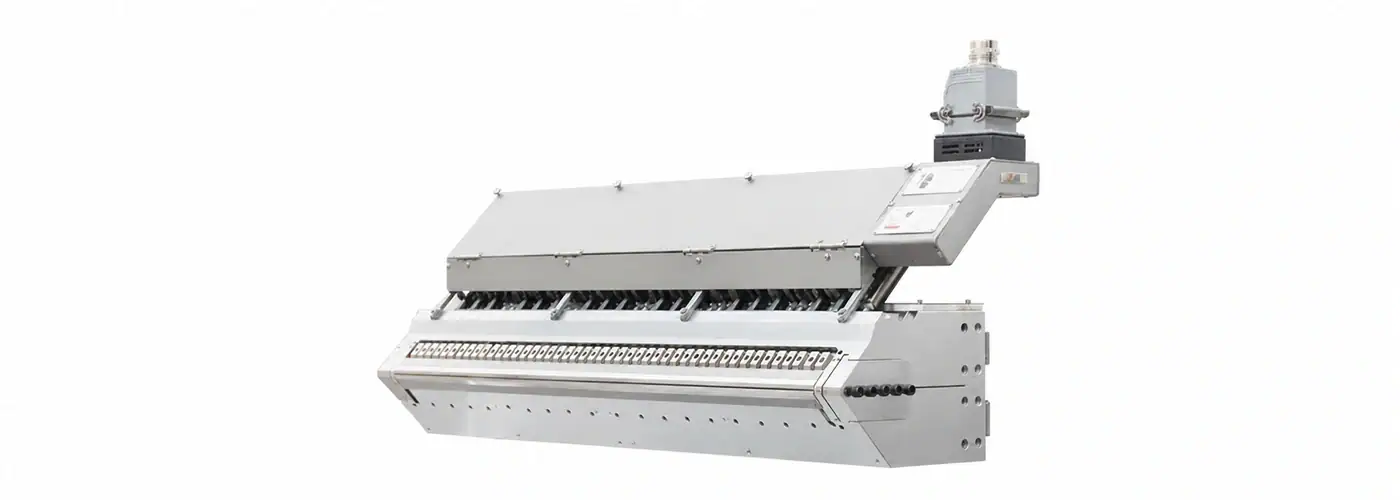
This biaxially oriented film die combines CFD-optimized flow channels with online thickness feedback and automatic thermal lip adjustment.
Key Selling Points
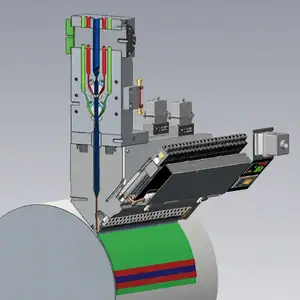
- Closed-Loop Adjustment: Online thickness data drives automatic thermal die-lip fine-tuning.
- CFD-Optimized Flow: Computer analysis supports coat-hanger channel parameter selection.
- Oriented Film Coverage: Documented for BOPP, BOPS, BOPA, BOPET, and BOPI products.
- Hardened Die Lip: Local hardening is specified for straightness and wear-resistance improvement.
- Push-Pull Control: Automatic lip adjustment supports rapid local opening correction.
Applications and Process Options
- Product families: BOPP, BOPS, BOPA, BOPET, and BOPI.
- Process stage: Cast sheet forming before biaxial stretching.
- Control: Online thickness gauge, computer processing, and thermal-expansion adjustment bolts.
- Flow design: Coat-hanger channel supported by CFD simulation and optimization.
Application Scenarios
Product Description
The JWELL biaxially oriented film die is a critical forming component for cast sheet used in biaxial stretching lines. Because the die directly influences cast-sheet shape and thickness uniformity, its flow channel and lip-control system are configured around material distribution and rapid thickness correction.
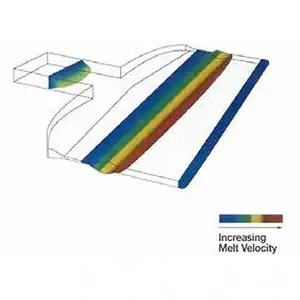
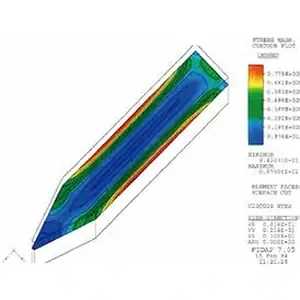
The die uses a coat-hanger flow-channel design. Professional computer fluid-analysis software is applied to simulate, analyze, and optimize the channel so that the flow parameters can be selected for the intended process. The source document includes CFD and melt-velocity analysis images as supporting design references, but it does not state a numeric uniformity tolerance.
For die-opening control, the system uses a push-pull automatic die-lip arrangement. Thickness data from an online gauge is processed by a computer program and fed back to special thermal-expansion adjustment bolts. These bolts automatically fine-tune local die-lip opening, allowing the line-control system to respond to detected thickness variation. The documented application range includes BOPP, BOPS, BOPA, BOPET, and BOPI products.
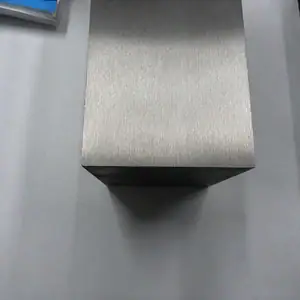
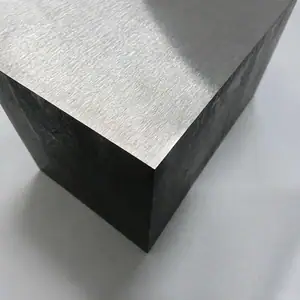
Die-lip straightness, surface roughness, and lip-edge geometry are identified as factors affecting product quality. The source states that local hardening improves surface hardness, refines the microstructure, and provides better straightness and wear resistance than conventional quenching. Numeric hardness, roughness, thickness tolerance, product width, output rate, die steel, and heating configuration are not supplied and should be confirmed during project engineering.