
From the window frames in your home to the intricate components in your car, plastic profile extrusion is a manufacturing process that shapes the world around us. What exactly is it, and how does it work?
In this guide, we’ll step into the profile extrusion process, explore its vast applications, and discuss the advanced machinery that makes it all possible. As a global leader in manufacturing plastic extrusion machinery, Jwell has a unique perspective on the technology that drives this versatile process.
What is Profile Extrusion?
At its core, profile extrusion is a high-volume manufacturing process used to create objects with a fixed cross-sectional profile. Imagine squeezing toothpaste from a tube—the toothpaste comes out in the shape of the tube’s opening. Profile extrusion works on a similar principle, but with molten plastic and a highly engineered die.
This process allows for the creation of continuous shapes, from simple tubes and rods to complex, multi-hollow window profiles. The key characteristics of extruded products are their consistent shape along their entire length, the ability to create intricate cross-sections, and the flexibility to be cut into various lengths.
Common Materials Used in Profile Extrusion
Thermoplastic materials can be used in profile extrusion, including:
- PVC (Polyvinyl Chloride): Widely used for pipes, window frames, and siding due to its durability and cost-effectiveness.
- PE (Polyethylene): Known for its flexibility and used for tubing, bags, and films.
- PP (Polypropylene): A versatile material used for automotive parts, packaging, and consumer goods.
- ABS (Acrylonitrile Butadiene Styrene): A rigid plastic used for pipes, fittings, and electronic enclosures.
- PC (Polycarbonate): A strong, impact-resistant material used for a variety of applications, including safety glasses and automotive components.
- Acrylic (PMMA): A clear, rigid thermoplastic offering excellent optical clarity and outdoor stability for transparent or decorative profiles.
- TPE / TPV: Elastomeric thermoplastics offering rubber-like sealing and flexibility while remaining processable on standard extrusion lines for seals and weatherstrips.
What Can You Make with Profile Extruder
The applications for profile extrusion are virtually limitless. Here are just a few examples of how this technology is used in our daily lives:
- Construction: Window and door profiles, siding, decking, railings, pipes, and conduits.
- Automotive: Seals, trim, tubing, and interior decorative parts.
- Electronics: Wire insulation, cable channels, and housings.
- Medical: Tubing for a variety of applications.
- Consumer Goods: Hoses, gaskets, and components for appliances.
- Lighting: LED diffusers and profiles.
The Profile Extrusion Process: 5 Steps Breakdown
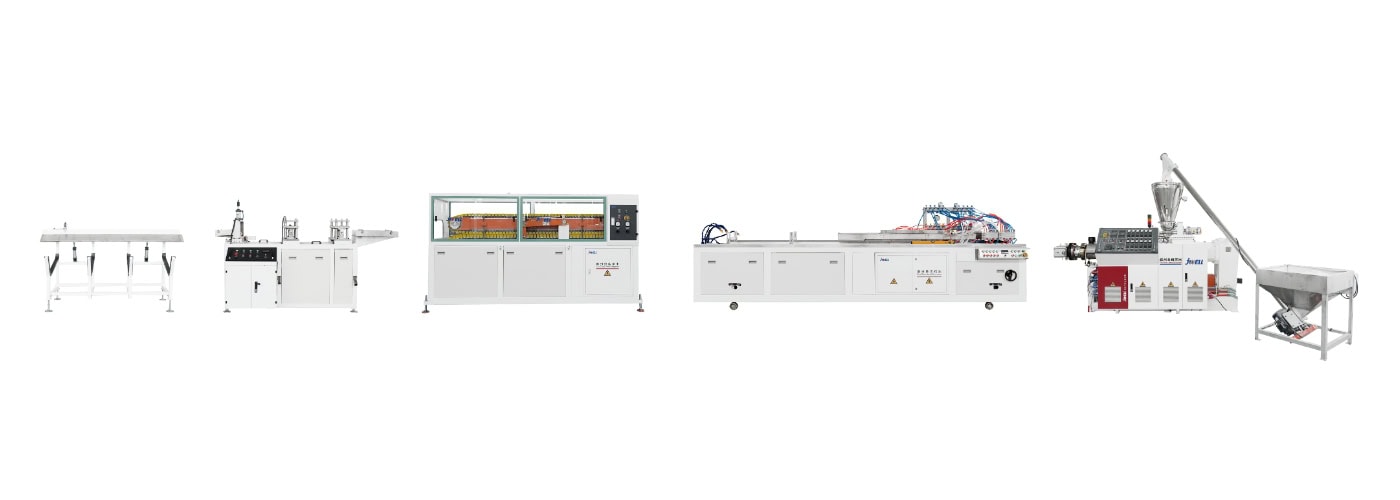
Achieving the perfect extruded profile requires precision at every stage. The entire operation is a seamless flow from raw material to finished product.
Step 1: Raw Material Feeding:
The journey begins with raw plastic, usually in the form of small pellets or granules. This material is loaded into a hopper, which feeds it steadily into the extruder’s barrel.
Step 2: Melting and Conveying:
Inside the barrel, a precisely engineered rotating screw takes over. It conveys the plastic forward while simultaneously subjecting it to intense heat from the barrel and the friction of its own movement. This combination melts the plastic into a homogenous molten state, ready for shaping.
Step 3: Extrusion Through the Die:
Now molten, the plastic is forced under pressure through a custom-made die. The die is the heart of the process. Its intricate design is what determines the final, exact shape of the profile.
Step 4: Sizing and Cooling:
The profile emerges from the die hot and still slightly malleable. It immediately passes into a cooling and sizing unit. Here, vacuum sizing tools and water cooling baths work together to solidify the profile into its final dimensions, ensuring precision and stability.
Step 5: Pulling and Cutting:
A “puller” (or haul-off) grips the solidified profile and draws it along the production line at a constant speed. This is critical for maintaining dimensional accuracy. Finally, the continuous profile is cut into its desired lengths by a saw or cutter.
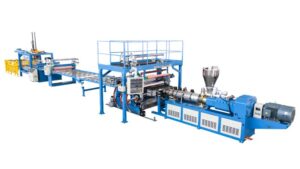
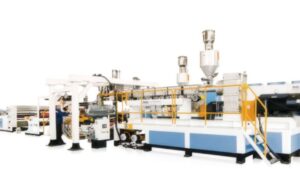
At Jwell, our extrusion lines are engineered as fully integrated systems to ensure peak performance and efficiency at every step, from the initial material feed to the final cut.
Exploring 4 Types of Profile Extrusion
While the basic process is straightforward, there are several more complex extrusion methods that allow for even greater versatility:
1. Single Material Extrusion
This is the most fundamental form of extrusion, using one type of plastic to create a simple, uniform part. It’s the straightforward, fast, and cost-effective method for producing items like basic PVC pipes, solid rods, and simple trim.
2. Co-Extrusion
This process combines two or more different materials or colors into a single profile. By feeding multiple materials into a special die, a single part can be created with distinct properties, such as a rigid structural core and a flexible, weather-resistant outer layer, all in one step.
3. Dual Durometer and Tri-Extrusion
A specific type of co-extrusion, this method bonds materials of different hardness levels. It is perfect for creating parts that need to be both rigid and flexible, such as a tool handle with a hard plastic core for strength and a soft, comfortable outer grip.
4. Crosshead Extrusion (or Jacketing)
This method is used to coat a core material (like a wire or cable) with a layer of plastic. The core is fed through the center of a special die as molten plastic is extruded around it, creating a seamless outer jacket. This is the standard process for insulating electrical wires and cables.
Jwell Machinery engineers and builds complete production lines for all these processes, providing the advanced, reliable equipment needed to create innovative and complex profiles.
Why Choose Jwell for Your Profile Extrusion Machinery?
At Jwell, we pride ourselves on providing the most advanced and reliable extrusion solutions on the market. Here’s why you should choose us for your profile extrusion machinery needs:
- Expertise and Innovation: We have decades of experience in the industry and are committed to research and development to create high-performance, reliable machinery.
- Comprehensive Solutions: We provide not just the extruder, but complete, turnkey extrusion lines, including downstream equipment like calibrators, haul-offs, and cutters.
- Customization: We can tailor machinery solutions to your specific needs, materials, and end-products.
- Global Reach and Support: We have a global presence and can serve and support customers worldwide.
Ready to start your next profile extrusion project or upgrade your production line? Contact Jwell experts today to discuss your requirements and discover the perfect extrusion solution for your business.
Frequently Asked Questions (FAQs) About Profile Extrusion
1. What is a “die” in the extrusion process?
The die is a highly engineered steel tool that gives the extruded profile its final shape. Molten plastic is forced through the precisely cut opening in the die, taking on its cross-sectional shape as it emerges. The design and quality of the die are critical to the accuracy and finish of the final product.
2. Can you create hollow parts with profile extrusion?
Yes. Dies can be designed with one or more pins or mandrels. These pins create voids within the profile as the plastic flows around them. This is how complex, multi-hollow parts like window profiles and certain types of tubing are manufactured in a single step.
3. How are extruded products cooled and finished?
After exiting the die, the hot, malleable profile is immediately pulled through a series of sizing tools and cooling baths (usually filled with water). This process solidifies the plastic and ensures its final dimensions are precise. Further down the line, the continuous profile is cut to its required length, and other operations like printing, drilling, or applying adhesive can be performed.
4. What is the main difference between extrusion and injection molding?
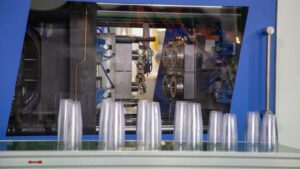
The primary difference is that extrusion creates continuous, linear parts with a consistent cross-section (like a pipe or a window frame), while injection molding creates discrete, three-dimensional objects in a closed mold (like a car dashboard or a plastic chair). Extrusion is for long, uniform shapes, whereas injection molding is for complex, standalone items.
5. What are the main advantages of using profile extrusion?
The main advantages are high volume and low cost. It’s extremely efficient for large production runs. It also allows for significant design flexibility in creating complex cross-sections and results in an excellent surface finish. Furthermore, the continuous nature of the process generates very little material waste.