PE100 pipe production requires a qualified pressure-pipe compound, an extrusion line matched to the diameter and wall range, sufficient cooling and a documented quality-control system. Purchasing a high-output extruder is only one part of establishing a repeatable pressure-pipe manufacturing process.
Begin with the destination market and application: water supply, gas distribution or industrial service. They can require different compounds and test programs. For US projects, PE100 terminology should not be treated as a substitute for the required ASTM material designation, such as PE4710; establish the customer’s specification before selecting resin or equipment.
What does PE100 mean?
PE100 is a polyethylene material strength classification with a minimum required strength, or MRS, of 10 MPa, based on extrapolated long-term hydrostatic strength at 20°C and 50 years. SDR and the design coefficient together determine the pressure rating. The classification is not a 10 MPa working-pressure rating for every pipe.
Standard dimension ratio is defined as:
SDR = nominal outside diameter ÷ nominal wall thickness.
The relationship between material strength, SDR and pressure also includes a service design coefficient. Temperature and application conditions must be considered. Consequently, an equipment quotation that specifies only “PE100 pipe” leaves important production requirements unresolved.
PE100-RC identifies material with enhanced resistance to slow crack growth under the relevant qualification framework. It should be specified deliberately when required by the project. It is not created simply by changing the screw speed or cooling settings on a standard PE100 line.
Specify the complete pressure-pipe compound
Buyers should identify the exact resin producer and grade, its qualification documents and the applicable product requirements. Melt-flow rate alone cannot establish pressure-pipe suitability. Two materials with similar processing flow can have different long-term performance and processing behavior.
|
Material consideration |
What the buyer should establish |
|---|---|
|
Compound identity |
Supplier, grade, lot and traceability records |
|
Long-term performance |
Evidence relevant to the material and intended application |
|
Processing window |
Supplier guidance for melt conditions and handling |
|
Color and stabilization |
Qualified compound or explicitly validated formulation |
|
Sag resistance |
Suitability for the intended diameter and thick wall |
|
Reprocessed material |
Whether and under what controls it is permitted |
Do not assume that adding black masterbatch to an arbitrary HDPE resin produces a qualified PE100 compound. Pigment dispersion, stabilization and base polymer selection must be assessed together. Likewise, recycled or externally sourced reprocessed material cannot be introduced solely because the extruder can melt it.
For large, thick-wall pipes, ask the compound supplier about low-sag grades. The molten wall must retain its distribution until cooling provides sufficient support. Excessive sag can produce a heavy lower wall and a thin upper wall even when the average mass per meter appears correct.
Match the extrusion system to the compound
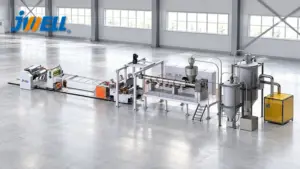
The basic line includes material conveying and dosing, a pipe extruder, a die, vacuum sizing, cooling tanks, haul-off, marking, cutting or winding, and product handling. Add laboratory equipment and utility systems to the project scope rather than treating them as later purchases.
A suitable screw must melt and homogenize the compound without excessive melt temperature or pressure instability. Ask for the proposed screw diameter, drive, control functions and operating range on the specified resin. Request measured melt temperature and pressure during the acceptance trial.
Polyethylene is non-hygroscopic under normal handling conditions, but pellets can still carry surface water or contamination. Keep conveying systems clean and protected from condensation. Follow the compound supplier’s handling instructions instead of adding a generic drying recipe to every PE100 project.
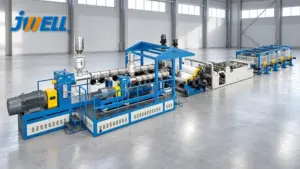
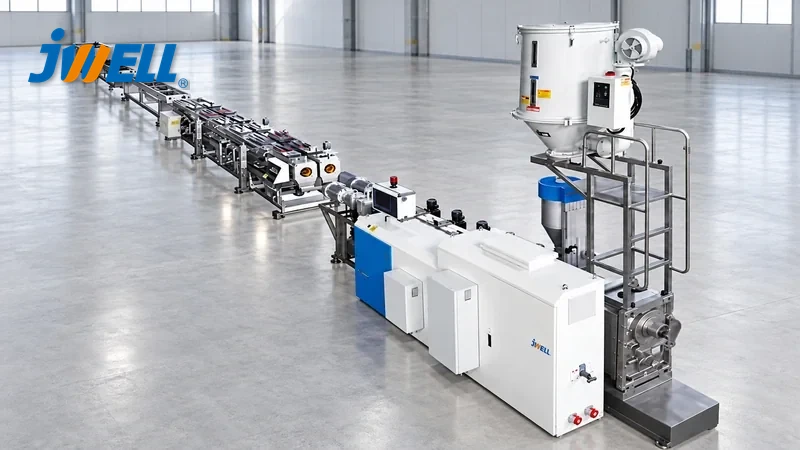
JWELL’s small-diameter plastic pipe extrusion line covers small-bore applications with feeding, extrusion and downstream forming equipment. Specify the PE100 compound and diameter/SDR combinations in the purchase enquiry so the screw, die and cooling capacity are sized for those products.
<!–WPIMG:0–>
Tooling and cooling control wall distribution
The die must distribute melt around the circumference without creating unacceptable temperature or flow differences. Centering adjustments, melt stability and tooling cleanliness influence the finished wall. Downstream equipment cannot fully correct an unstable melt distribution.
Vacuum sizing establishes external geometry while cooling removes heat. For thick walls, the outside may appear solid while the core remains hot. Insufficient cooling can lead to ovality, dimensional drift or distortion during haul-off and cutting.
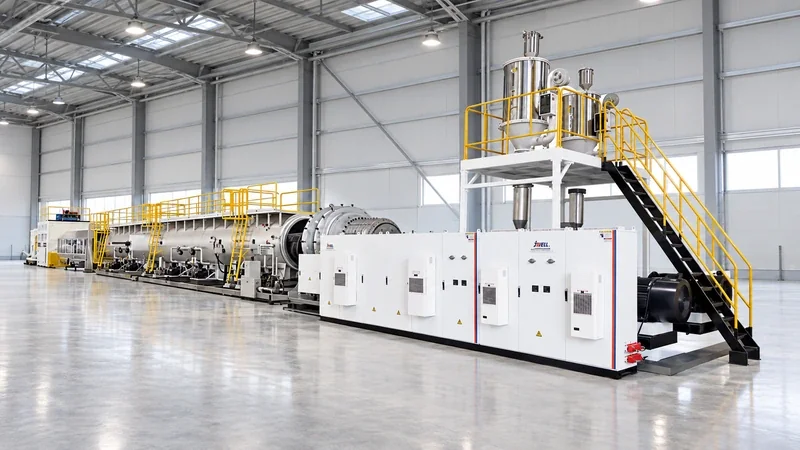
For larger products, the JWELL large-diameter HDPE solid-wall pipe line uses a spiral-distribution die and an internal-cooling arrangement. Thick-wall production needs both suitable low-sag resin and enough cooling time to preserve the wall distribution through haul-off and cutting.
Plan utility capacity around the agreed operating point. Specify incoming water temperature, circulation flow, heat rejection, water treatment and ambient conditions. Total installed electrical power should be separated from measured running consumption.
<!–WPIMG:1–>
Translate kilograms per hour into pipe output
Pipe buyers sell accepted length, while extruder capacities are often quoted in kilograms per hour. Convert between them using the intended wall dimensions.
For a uniform solid-wall pipe:
Mass per meter (kg/m) = π × (D × t − t²) × ρ × 10⁻⁶, where D and t are in millimeters and density ρ is in kg/m³.
As an illustration, a pipe with D = 110 mm, t = 10 mm and assumed density 950 kg/m³ weighs approximately 2.98 kg/m. At 300 kg/h reaching the pipe, the calculated speed is about 1.68 m/min. This example excludes dimensional tolerances and is not a specified product weight or line guarantee.
If the line actually runs at 300 kg/h for 85% of an eight-hour shift and 97% of that production passes inspection, accepted output is approximately 1,979 kg. This assumes no speed loss during running time. If the machine runs below 300 kg/h, use its measured rate or include a separate performance factor.
Build quality checks into the project
Agree the production and laboratory control plan before ordering. Relevant checks may include dimensions, ovality, appearance, mass, compound identity, melt-flow behavior, oxidation stability, pigment dispersion and hydrostatic performance, depending on the selected specification.
Online wall measurement can help operators identify drift, but it needs calibration and a response procedure. Set alarm limits and tell operators which adjustments to make when the wall profile drifts.
The acceptance trial should cover a representative production diameter and a demanding wall condition. Record actual material, melt conditions, speed, cooling water, dimensions and rejected lengths. Confirm which tests are completed during the trial and which require longer laboratory schedules.
Also define marking content, batch traceability, sample retention and the release process for finished pipe. Procurement should include training and commissioning documentation so the accepted process can be reproduced after installation.
FAQ
Does PE100 automatically mean a particular pressure rating?
No. The pipe dimensions, design coefficient, application and operating conditions also determine the pressure basis.
Can the same line make different SDRs?
Often yes, within its configured tooling, extrusion, cooling and haul-off limits. Ask for output and quality evidence at the thickest and thinnest planned walls.
Is a larger extruder always the safer purchase?
No. An oversized system can be difficult to operate efficiently on small products. Match the operating range to the expected production mix.
Can equipment acceptance replace pipe qualification?
No. Machine performance, compound qualification and finished-pipe conformity are connected but separate responsibilities.
Request a Quote for a JWELL PE100 Pipe Extrusion Line
Equip your plant with a JWELL HDPE pipe extrusion line configured for your PE100 compound and pipe sizes. JWELL offers small-diameter and large-diameter solid-wall pipe equipment; request a quotation that includes the screw and die arrangement, sizing and cooling tanks, haul-off, and cutting or winding equipment for your production schedule.
Send your compound grade, destination specification, outside diameters, SDR range and required output to JWELL Anhui sales. Add available factory space and cooling-water conditions to obtain a purchase proposal for the appropriate line and tooling.