Among food packaging materials, APET is a common choice for clear chilled-food trays, PP is a candidate for reheatable containers, and conventional clear PLA suits cold-food packs where the customer specifies PLA and has a suitable recovery route. Select the grade and package design against the actual filling, transport and heating conditions.
For manufacturers buying a sheet extrusion line, this decision affects drying, screw design, cooling, winding and thermoforming. Compare the materials through a package trial and cost per accepted pack before choosing equipment around a resin name.
Compare the finished package requirements first
|
Requirement |
PET sheet |
PP sheet |
PLA sheet |
|---|---|---|---|
|
Clear retail presentation |
Common APET application |
Grade and forming conditions matter |
Suitable transparent grades available |
|
Heated service |
Distinguish APET from engineered CPET structures |
Investigate suitable thermoforming grades |
Conventional clear PLA requires careful thermal limits |
|
Moisture management before extrusion |
Drying or validated devolatilization required |
Usually surface moisture and contamination control |
Grade-specific drying is important |
|
Forming behavior |
IV and heating consistency matter |
Sag, shrinkage and crystallization matter |
Molecular-weight retention and thermal history matter |
|
End-of-life design |
Verify local tray collection and acceptance |
Verify local PP packaging acceptance |
Verify certified product and receiving infrastructure |
This table is a screening tool. It does not establish food-contact suitability or a maximum service temperature. Those decisions require documentation for the actual formulation and testing of the complete pack, including its lid, label and seal.
PET: prioritize clarity and controlled processing
Amorphous PET, commonly called APET, is widely used where visual presentation and rigidity are important. A clear produce tray, salad container or chilled-food clamshell may therefore begin with a PET trial.
Distinguish APET from CPET, which uses controlled crystallization and a suitable formulation and forming process. A standard transparent APET tray should not be treated as ovenable simply because another PET-based package tolerates higher temperatures.
PET processing must limit moisture-related molecular degradation. Incoming intrinsic viscosity, drying performance, melt temperature and residence time influence the sheet delivered to thermoforming. Recycled PET also introduces questions about contamination, color, consistency and documented suitability for the intended use.
When comparing proposals, request sheet samples made with the intended virgin/recycled blend. Evaluate haze, color, thickness profile, forming consistency and scrap. Successful processing of clean virgin pellets does not establish performance on variable bottle flakes.
PP: investigate heat performance and lightweighting
For reheatable trays and food containers, start with a PP grade designed for sheet extrusion and thermoforming. Melt strength controls sag before the sheet reaches the mold, while stiffness and impact resistance affect stacking and handling. An injection-molding grade chosen mainly for high flow may be unsuitable for this job.
Several PP product families are sold for extrusion thermoforming, each with different performance attributes. Select among grades using the package’s forming depth, impact requirements, appearance and service conditions.
PP has a lower density than PET, which can reduce mass at equal sheet volume. However, equal sheet thickness does not mean equal package performance. Rigidity, wall thinning and stacking requirements can change the material needed per accepted container.
PP also requires control of shrinkage and crystallization. Cooling-roll conditions and thermoforming heating must be developed together. A pack that looks acceptable immediately after forming may still distort during stacking, storage or filling.
<!–WPIMG:0–>
PLA: clear cold-food packs and grade-specific heat limits
PLA is a polyester available in extrusion and thermoforming grades. It can support transparent fresh-food packaging and food-service applications when its mechanical and thermal properties fit the design. Grade selection includes both general-purpose and crystallization-oriented options.
Conventional clear PLA is sensitive to heat. A typical heat-distortion temperature for clear extrusion-grade PLA is around 55°C. That laboratory value is not a package service-temperature rating, but it shows why hot filling, heated transport and microwave use need separate evaluation. Crystallized or modified PLA formulations can behave differently.
PLA also needs moisture control. Follow the selected supplier’s drying guidance and protect dried material from reabsorption. Regrind must be managed as a separate material stream because moisture and repeated thermal history can change forming behavior.
Claims about compostability require a defined finished product, certification basis and receiving system. A resin description alone does not establish that a multilayer tray, printed label and adhesive are accepted by the destination composting facility.
<!–WPIMG:1–>
Barrier and sealing can change the decision
Material selection cannot rely on clarity and temperature alone. Identify whether the food requires oxygen, moisture, aroma or grease protection. Evaluate the complete package, because seal leakage can overwhelm differences in the sheet’s intrinsic barrier properties.
Multilayer structures may improve performance, but they add coextrusion, dosing and adhesion requirements. Specify each layer’s function and evaluate the structure’s compatibility with the intended waste stream. Do not assume a barrier layer is needed before the food shelf-life requirement has been established.
Run sealing trials with the actual lidding film. Record sealing temperature, pressure, dwell time, peel behavior and leak results. Include contamination at the seal area when that reflects the filling process.
Compare cost per accepted package
Use the following structure:
Material cost per accepted pack = resin cost consumed during the run ÷ accepted packs produced.
Then add drying, extrusion, thermoforming, labor and waste-handling costs. For material costing, count net resin consumed after inventory changes and recoverable trim, rather than charging recirculated skeleton scrap as newly purchased resin on every pass. Its extra processing energy and any loss in quality still belong in conversion costs.
For an illustration, a 15 g pack at an assumed resin price of USD 1.20/kg contains USD 0.018 of resin before losses. A 10% increase in accepted pack weight raises that figure to USD 0.0198. These are arithmetic examples, not current resin quotations or recommended package weights.
Compare several design iterations. A more expensive resin may still be competitive if it delivers a lighter accepted pack or a more stable process. The opposite can also occur when higher scrap or longer forming cycles offset its apparent material advantage.
Define equipment flexibility precisely
A multi-material machine requires compatible process windows and a practical changeover procedure. Confirm the screw, venting or drying system, die, melt filtration, roll stack and controls for every planned material. Ask how contamination is removed between PET, PP and PLA campaigns.
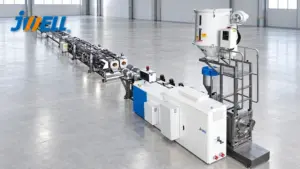
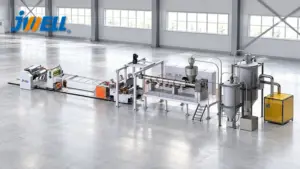
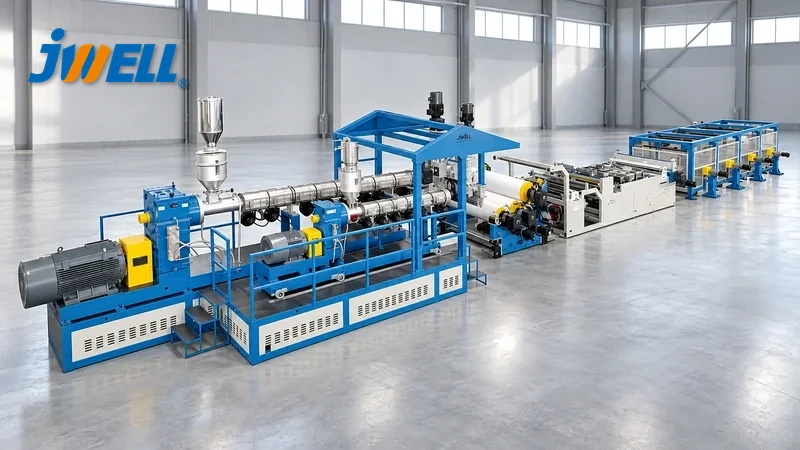
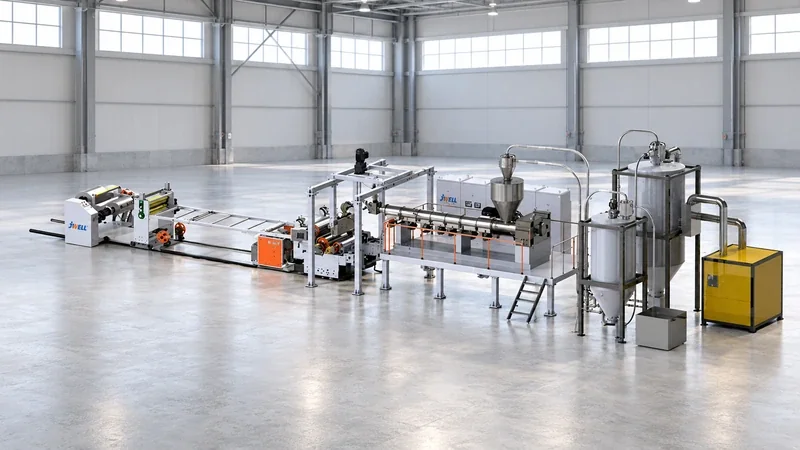
JWELL supplies a PP/PS sheet extrusion line for PP sheet projects and a PLA sheet extrusion line for appropriate PLA formulations. Specify net sheet width, gauge, layer structure and resin blend when requesting a machine quotation. Those details determine the necessary extrusion, roll cooling and winding equipment.
Make the acceptance trial include both sheet inspection and thermoforming. Sheet that winds successfully can still fail during deep drawing, sealing or stacking. Retain the approved sample pack and its process settings as the production reference.
FAQ
Which material is best for microwave packaging?
A suitable PP thermoforming grade is a common starting point for microwave containers. Test the complete pack with the intended food, heating time and temperature; the lid and seal must also be suitable.
Is recycled PET automatically suitable for food packaging?
No. The source, recycling process, formulation and intended use require relevant documentation and evaluation. Visual clarity does not establish suitability.
Can PET, PP and PLA run with identical settings?
No. Their moisture sensitivity, melt behavior and cooling requirements differ. Use material-specific operating procedures and trials.
Does PLA always provide the best environmental outcome?
No universal conclusion follows from the resin name. Package mass, production, product protection, transport and actual recovery or disposal conditions all affect the assessment.
Request a Quote for a JWELL PET, PP or PLA Sheet Extrusion Line
Choose JWELL sheet extrusion equipment for your next PET, PP or PLA packaging project. JWELL offers PP/PS, PLA and PET-based sheet-line configurations; request a quotation for the material, layer structure and sheet dimensions your thermoforming operation needs.
Send your resin grade, recycled-content target, net sheet width, thickness range and required kg/h to JWELL Anhui sales. Include a sample tray or drawing and your forming requirements so the offer covers the extrusion system, material preparation, roll stack and downstream equipment suited to the purchase.