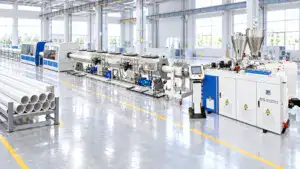
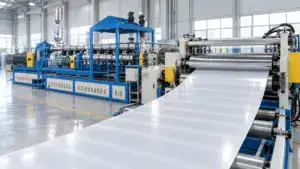
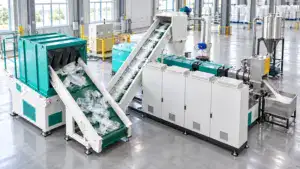
Medical fiber and nonwoven lines demand uninterrupted production, consistent quality, and adaptability to gowns, drapes, curtains, and hygiene products.
If you are choosing a spinning machine, you should ask, “Can it give me the fiber quality and fabric performance my market needs?”
How a Spinning Machine Works in Medical Nonwoven Production
A spinning machine for medical fiber and nonwoven applications turns polymer into continuous filaments, then into a usable web or composite structure. In many medical nonwoven lines, this process is integrated into a continuous production system.
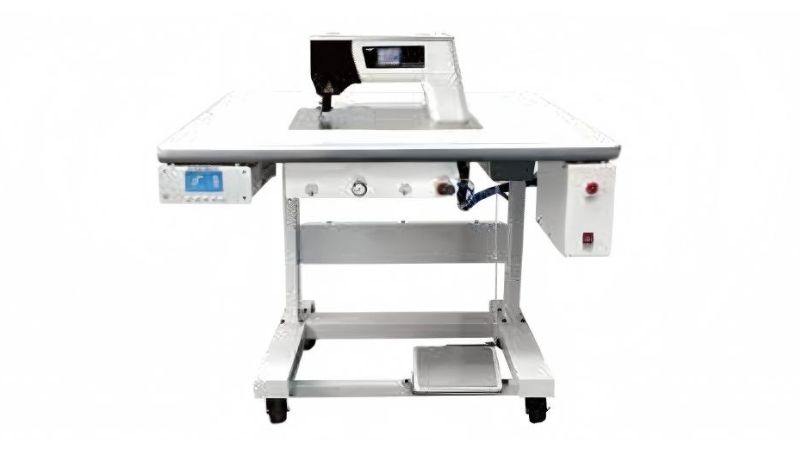
From Polymer Feeding to Fiber Formation
The process starts when polymer is fed into the extrusion system. The material is melted, filtered, and sent to the spinning beam. Then it passes through a spinneret, where the melt is formed into fine filaments.
This step is critical because fiber formation affects everything that comes after it. If melt flow is uneven or the spinneret is not precise, you may see:
- unstable filament diameter
- weak web formation
- poor fabric consistency
- more waste
Spunbond and Meltblown Work Together
For many medical products, a single fiber layer is not enough. You often need both strength and barrier performance. That is why SMS structures are widely used.
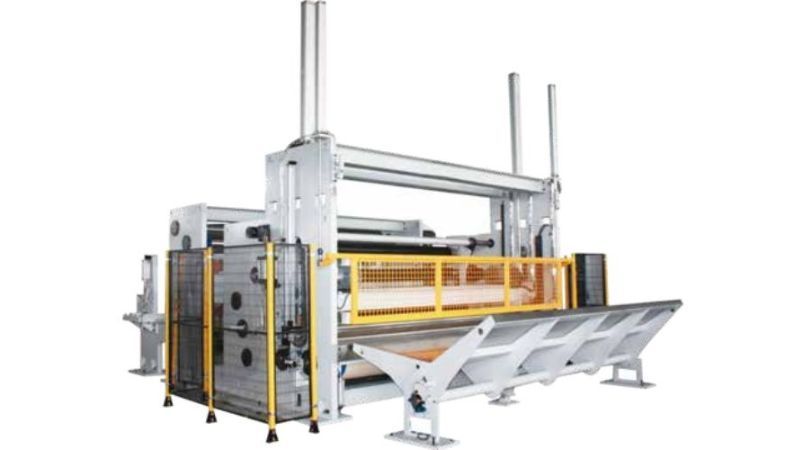
In Jwell’s one-step SMS production line, the material is built into a three-layer structure: spunbond on the outside and meltblown in the middle. The outer spunbond layers give you:
- strength
- softness
- better handling
The inner meltblown layer gives you:
- filtration performance
- barrier function
- fine fiber structure
This combination offers softness and reliable protection for medical and hygiene applications.
Bonding and Web Consolidation
Once the web is formed, it must be bonded into a stable fabric. Jwell’s SMS line uses hot roller lamination technology to combine the layers into one composite material.
For you, this means the spinning machine is not only a fiber-forming machine. It is part of a full system that also controls:
- layer bonding
- web integrity
- final hand feel
- fabric consistency
If bonding is poor, even good fibers may not give you a good product.
What Affects Output Quality in Medical Fiber and Nonwoven Lines
If you want stable output, you need more than a good machine layout. You need every part of the process to work together.
Spinneret Precision and Fiber Uniformity
One of the biggest quality factors is spinneret precision. If the spinneret holes are accurate and the melt flow stays stable, your filaments will be more uniform. That helps you build a more even web and a more consistent fabric.
Line Speed, Width, and Basis Weight Control
A high-speed line sounds attractive, but speed only helps you if quality stays stable. Jwell lists SMS line speeds of under 300 m/min, effective widths of 1600 mm, 2400 mm, and 3200 mm, and a basis weight range of 9–80 g/m².
That range matters because different medical and hygiene products need different fabric weights. Lightweight materials may be used where softness and breathability matter more. Heavier materials may be needed where added coverage or strength is required.
Here is a simple reference chart:
| Production Factor | Why It Matters | What You Should Watch |
| Spinneret precision | Affects filament uniformity | Fiber diameter consistency |
| Line speed | Affects output and stability | Whether quality holds at target speed |
| Basis weight control | Affects product performance | Fabric weight variation |
| Effective width | Affects production scale | Match to product width needs |
| Bonding system | Affects web strength and feel | Layer integrity and softness |
Material Structure and Medical Performance
In medical applications, fabric structure directly affects how the material performs in use. Jwell describes SMS fabric as combining durability, protective function, and user comfort, which is why it is used in disposable medical and hygiene products.
If you supply medical markets, you should focus on whether your spinning machine can help you achieve:
- stable barrier performance
- repeatable fabric softness
- uniform web structure
- continuous production with low defects
These points are often more important than simple output numbers.
How You Choose the Right Spinning Machine for Your Application
The best spinning machine is the one that matches your product plan, not just your budget. You should choose based on what you want to produce, how much you want to produce, and how stable your output must be.
Match the Machine to the End Product
Different products need different line priorities. If you make surgical gowns, you may focus on barrier and softness. If you make hygiene materials, you may focus on output, softness, and cost control. If you make composite medical fabric, you may need more precise layer control.
Here is a practical comparison:
| End Product | What You Need Most From the Machine |
| Surgical gowns | Barrier performance, softness, stable composite structure |
| Surgical drapes | Uniform web, controlled basis weight, good coverage |
| Hospital curtains | Consistent width, strength, reliable long-run output |
| Diapers and hygiene products | Soft texture, high output, good material uniformity |
| Incontinence products | Stable quality, repeatable fabric structure, efficient production |
Think About Scalability, Not Only Startup
You should also think about what happens after installation. A machine may meet your current need, but can it also support new products or wider output targets later?
Use a Simple Machine Selection Checklist
Before you choose a spinning machine, ask yourself these questions:
- What products will you run most often?
- What basis weight range do you need?
- Do you need spunbond only, meltblown only, or SMS composite?
- How important are softness and barrier performance in your market?
- Do you need room for future capacity growth?
If your answers are clear, your machine choice becomes easier and safer.
Partner with Jwell for a Reliable Medical Nonwoven Production Solution
If you want strong results in medical fiber and nonwoven production, you should focus on more than output. You should look at fiber uniformity, layer structure, bonding quality, and long-run stability. When these factors work together, your spinning machine becomes a real production asset.
At Jwell, we provide customized production solutions for medical applications and advanced nonwoven systems designed for stable, high-quality output. If you are planning a new project or upgrading your current line, contact Jwell to discuss a spinning machine solution that fits your product, capacity, and market goals.
Frequently Asked Questions
What is a spinning machine in nonwoven production?
A spinning machine forms polymer melt into fine filaments and helps build a continuous nonwoven web for further bonding and finishing.
Why is SMS important for medical nonwoven applications?
SMS combines two spunbond outer layers with a meltblown middle layer. This gives you a good balance of strength, softness, and barrier performance for medical and hygiene products.
What products can you make with this type of machine?
You can produce materials for medical isolation gowns, surgical gowns, drapes, hospital bed sheet curtains, sanitary products, diapers, and adult incontinence products.
What line speed can an SMS nonwoven line reach?
Jwell’s SMS spunmelt nonwoven line is listed at under 300 m/min, depending on the model and production conditions.
Why does spinneret precision matter?
It affects filament uniformity, web quality, softness, and final fabric consistency. Better precision usually means more stable product quality.
How do you choose the right line width?
You should match the width to your product size, target output, and plant plan. Jwell lists 1600 mm, 2400 mm, and 3200 mm options for its SMS line.