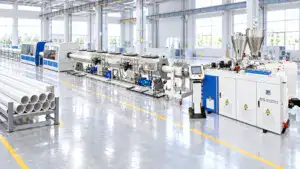
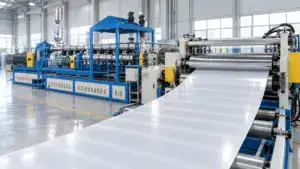
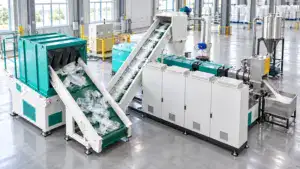
An extruder uses a rotating screw in a heated barrel to melt and push plastic through a die.
This article introduces the core principles that make extrusion work, the key components involved, different types of extruders, and the critical parameters that control the quality of your final product.
Core Operating Principles of Extruders
Extruders transform raw materials into finished products through three key stages: conveying solid materials, melting them under heat and pressure, and shaping the plastic melt through a die.
Stages of Material Transformation
Your extruder processes materials through distinct zones along the screw. The feeding zone receives raw pellets or powder and moves them forward. Next, the compression section reduces space between screw flights, creating pressure that generates heat through friction.
The material begins melting as it compresses. Finally, the metering section maintains consistent pressure and temperature to create a uniform plastic melt ready for the machine head.
How Extruders Convey, Plasticize, and Shape
The extruder screw acts like a pump, pushing material forward with its rotating flights. As screw rotation continues, mechanical energy converts to heat through friction. Your barrel temperature adds external heat to complete plasticization.
The compressed material becomes a homogeneous melt. This plastic melt then moves to the die, where extrusion molding creates your desired shape.
Role of Screw Rotation and Barrel Temperature
Screw rotation speed controls your production rate and mixing intensity. Faster rotation increases output but may reduce melt quality. Barrel temperature works with friction heat to achieve proper melting without degrading your material.
You need to balance both parameters for optimal results.
Key Components and Their Functions
Extruder’s performance depends on how well its main parts work together. The hopper feeds material into the system, while the screw and barrel transform it into a melt. Heating and cooling systems control temperature, and the die shapes your final product.
Hopper and Material Feeding System
The hopper sits at the top of your extruder and stores raw material before it enters the machine. Your material might be granules or powder, and the hopper design affects how smoothly it flows.
A good feeding system keeps material moving at a steady rate. Some hoppers include features like agitators or vibrators to prevent bridging, which happens when material gets stuck. The feed throat connects the hopper to the extruder screw and often has water cooling to stop material from melting too early.
Screw and Barrel Design
The extruder screw is the heart of your extrusion system. It pushes material forward while melting and mixing it. Your screw design includes three zones: the feed zone moves solid material, the transition zone melts it, and the metering zone pumps it toward the die.
Thread pitch and depth change along the screw length. A deeper feed screw grabs more material, while shallower channels build pressure. The barrel surrounds the screw and provides a heated surface for melting.
Heating and Cooling Systems
Your temperature control system uses heater bands wrapped around the barrel. Each zone has separate controls so you can set different temperatures along the barrel length.
The cooling system prevents overheating. Water cooling or air cooling keeps the feed throat and gearbox at safe temperatures. Heat-sensitive materials need precise control to avoid degradation.
Die and Post-Extrusion Equipment
The machine head and die sit at the end of your extruder. Extrusion dies shape the molten plastic into pipes, profiles, or sheets. Your die design determines the final product dimensions.
The drive system powers the screw rotation. After leaving the extrusion die, your product goes through cooling tanks or air knives to solidify it.
Main Types of Extruders and Their Unique Mechanisms
Single-screw and twin-screw extruders work differently based on their screw arrangements.
Single-Screw Extruders
A single-screw extruder uses one rotating screw inside a heated barrel to move and melt plastic. The screw pushes material forward while friction and barrel heat melt the polymer. This design is simple and cost-effective for your basic extrusion needs.
You’ll find single-screw extruders work well for blown film and cast film production. They’re reliable for processing uniform materials that don’t need intensive mixing.
Twin-Screw and Multi-Screw Extruders
Twin-screw extruders use two intermeshing screws that can rotate in the same direction (co-rotating) or opposite directions (counter-rotating). Co-rotating designs provide better mixing and material dispersion. Counter-rotating twin screw extruders offer more precise control over residence time.
These systems excel at compounding filled polymers and blending multiple materials. You get superior control over shear, temperature, and additive incorporation compared to single-screw designs.
Comparative Advantages for Polymer Processing
Single-screw extruders offer you lower equipment costs and simpler operation for straightforward applications. Twin-screw systems provide enhanced mixing capabilities and flexibility for complex formulations. Your choice depends on whether you need basic melting and shaping or advanced compounding with multiple additives.
Critical Process Parameters and Control for Quality
Temperature control and speed management form the foundation of quality extrusion, while proper venting and cooling ensure your final product meets specifications.
Temperature and Speed Control Strategies
Barrel temperature directly affects material viscosity and melt quality in your extruder. You need to adjust temperature zones based on your specific material to achieve proper melting and flow consistency.
Speed control involves managing both screw rotation and traction speed. Your screw speed determines how quickly material moves through the barrel, affecting residence time and mixing. Higher speeds increase output but can compromise temperature uniformity if not balanced correctly.
Key Control Parameters:
- Barrel temperature zones (feed, compression, metering)
- Screw rotation speed
- Traction speed for downstream equipment
You should monitor these parameters continuously to maintain production stability. Small temperature variations can cause inconsistent melt flow through your extrusion die, leading to defects in the extruded product.
Venting and Handling High-Viscosity or Heat-Sensitive Materials
Venting removes trapped air and volatile compounds from your melt stream. This prevents bubbles and contamination in products like sheet extrusion applications.
Heat-sensitive materials require careful temperature management to avoid degradation. You’ll need lower barrel temperatures and faster processing times to protect material properties.
Cooling, Shaping, and Post-Processing Operations
Cooling and shaping happen immediately after the extrusion die. For sheet extrusion line operations, you’ll use calibration equipment and cooling rolls to set dimensions. Air rings cool tubular products uniformly in film applications.
Post-processing includes pelletizing for compound production or cutting extruded products to length. These operations must match your line speed to maintain quality.
Partner with Jwell for a Reliable Medical Nonwoven Production Solution
The right extruder setup helps you run faster with control. When your screw geometry matches your material and product, you get more stable melting, more consistent pressure, and better output quality.
At Jwell, we understands how extruder design, screw structure, and downstream configuration affect real production results. If you are planning a new high-output line or improving an existing one, contact us to discuss an extrusion solution built for your material, capacity, and product goals.
Frequently Asked Questions
How does a single-screw extruder work from start to finish?
A single-screw extruder feeds material through a hopper into a heated barrel. The screw rotates and pushes the material forward while heat softens it. As the material moves through the barrel, it melts and becomes uniform. The screw then forces this melted material through a die that shapes it into the final form.
What are the main stages in the extrusion process, and what happens in each one?
The feeding stage introduces raw material into the barrel. During the compression stage, the material heats up and gets squeezed together. The metering stage makes sure the melted material stays consistent. Finally, the die shapes the material into your desired product.
What’s the difference between single-screw and twin-screw extruders in how they operate?
Single-screw extruders use one rotating screw to push material forward. Twin-screw extruders have two screws that work together. Twin-screw designs mix materials better and give you more control over temperature.