If you want to understand how everyday items like cups, trays, and car dashboards are made, you need to look at sheet extrusion. It is a core polymer processing method used to create flat, continuous plastic materials. This guide will walk you through how the sheet extrusion process works, the equipment involved, and why it is such an important solution in modern manufacturing.
What is the Plastic Sheet Extrusion Process?
The sheet extrusion process is a manufacturing method that converts raw plastic granule material into a flat plastic sheet. In this process, the plastic is heated, melted, and forced through a shaped die to create a flat profile.
The extrusion process is widely used because it provides a reliable, high-volume way to create sheets of varying thickness. Whether you are making thin material for flexible wrapping or a thick board for the automotive sector, sheet extrusion is the foundation.
This process starts when you feed raw material into an extruder. The material is pushed forward by a screw that helps melt and mix the polymer. Once it is molten, it is shaped and cooled into a solid state.
Key Components in Sheet Extrusion Systems
To achieve high-quality output, you need precise control over several pieces of equipment. Modern sheet extrusion lines rely on different parts working together to maintain the right gauge and quality.
If you are setting up a process, here are the main parts you will see:
| Component | Function |
| Extruder | Melts and mixes the plastic using a rotating screw |
| Melt Pump | Ensures steady pressure and consistent flow |
| Sheet Die | Shapes the melted plastic to the right width and thickness |
| Roll Stack | Uses a series of rollers to cool and finish the sheet |
| Cooling System | Further cools the sheet as it travels down the line |
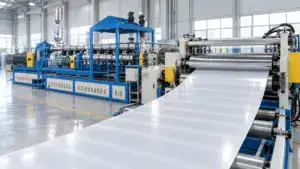
In a typical setup, the extrusion die has an adjustable lip to fine-tune the thickness. After the die, the hot plastic enters a chill roll stack—often a three-roll downstack—where the material begins to cool and solidify.
Common Materials and the Power of Coextrusion
The beauty of the sheet extrusion process is how versatile it is. A wide range of materials can be used, depending on the application.
The most common plastics include:
- PET (often used for food packaging)
- PP (great for items needing heat resistance)
- PE (used for its toughness and chemical resistance)
When a single material isn’t enough, manufacturers use coextrusion. This involves using several extruders to feed different materials into one die, creating a multi-layer sheet. For example, you might combine a strong core with a barrier layer to keep food fresh, or add a special coating to block UV light. You can also mix in a special additive or compound to change the color or strength of the formulation.
How to Optimize the Extrusion Process
To stay competitive, a manufacturer must focus on efficiency and quality. If your process is unstable, you will face variation in thickness and wasted material.
To optimize the line, a good processor will pay attention to material preparation. Many plastics, like PET, must be thoroughly dry before they enter the extruder to prevent defects.
Here are a few ways to improve your output:
- Use an advanced control system for real-time monitoring of thickness.
- Control the speed and temperature of each roll closely.
- Ensure the melt temperature remains uniform throughout the run.
- Use an in-line scanner to catch defects early.
A precise setup helps reduce scrap and meets the growing demand for sustainability by making the most out of every plastic pellet.
Key Advantages and Applications in Industry
The versatility of sheet extrusion makes it a cost-effective and innovative choice for many sectors. It allows for the high-volume production of a uniform product.
The biggest advantage is that the finished sheet is often just the starting point. The sheet can be sent through a slit machine to cut it to size, or sent to a lamination station. Very often, the sheet goes straight into thermoforming, where it is heated and molded into its final shape.
You will see this technology used across the following areas:
- Packaging: For thermoformed packaging, trays, and blister packs.
- Automotive: For interior panels and underbody parts.
- Construction: For wall panels and foam insulation boards.
- Medical: For sterile trays and device covers.
Even materials like glass fiber reinforced plastics can be processed into flat sheets for heavy-duty industrial use.
Frequently Asked Questions
What is the difference between film and sheet extrusion?
The main difference is thickness. While both use similar extrusion systems, anything under 0.25mm is generally considered film, and anything thicker is considered a sheet.
Can sheet extrusion lines use recycled plastic?
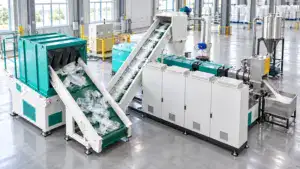
Yes. Many modern lines can feed recycled plastic flakes or pellets, which helps improve sustainability and lowers material costs.
What is the role of the roll stack?
The stack of rollers helps to cool the plastic as it exits the die. It also determines the final surface finish (like smooth or textured) and helps lock in the final gauge of the sheet.
Looking for a Reliable Plastic Extrusion Machine Manufacturer?
JWELL is a professional manufacturer focused on plastic extrusion machines and complete extrusion line solutions. We offer a wide range of equipment for pipe, profile, sheet, board, film, compounding, recycling, and other plastic processing applications.
If you are looking for a reliable manufacturer or supplier, please send us an inquiry. We’re happy to help you find the right extrusion equipment for your production needs.