Jwell Continuous Screen Changer with Dual Hydraulic Plates
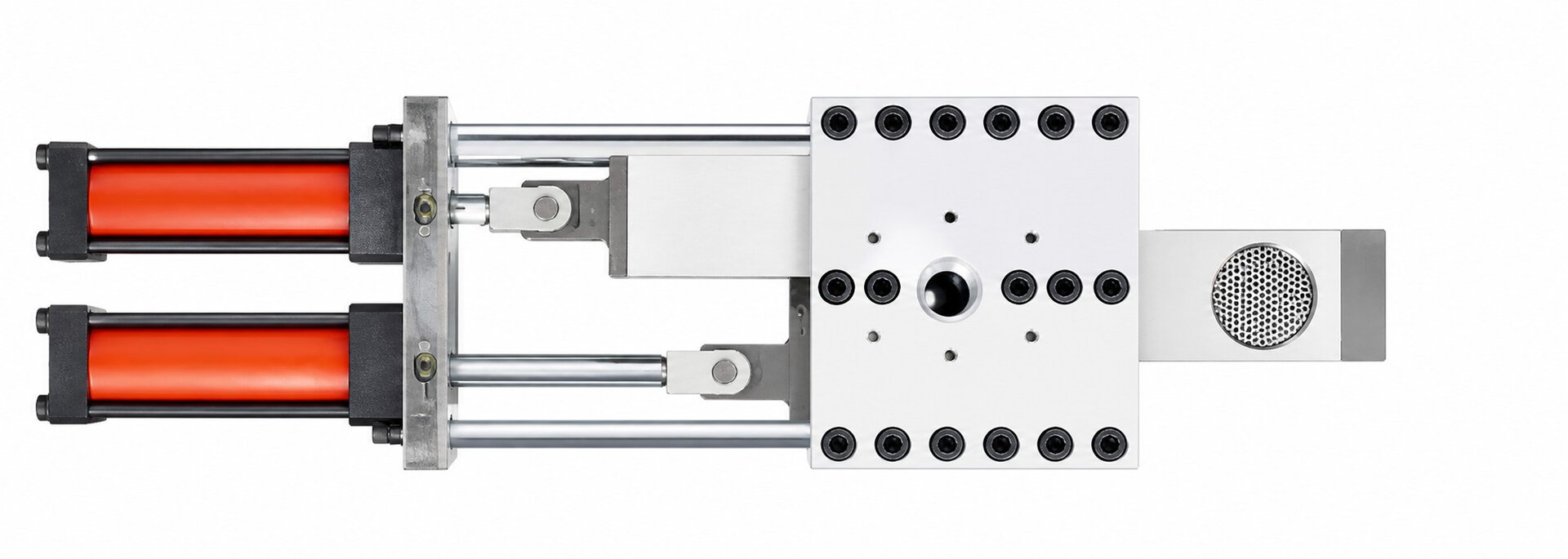
This continuous screen changer alternates two hydraulic plates to maintain melt flow during screen changes, with pressure sealing and modular construction.
Key Selling Points
- Continuous Melt Flow:Alternating plates maintain material delivery during screen changes.
- Process Repeatability:The operating mode supports stable, repeatable extrusion conditions.
- Dual Filtration Area:Nine models list paired filter areas up to 70,685×2 mm².
- Reduced Flow Shear:Rheology-optimized breaker plates support the melt path.
- Modular Integration:Designed for different standard extrusion machines and convenient cleaning.
Technical Parameters
| Model | Output (kg/h) | Filter Size (mm) | Filtration Area (mm²) | Max. Pressure (MPa) | Heating Zones | Heating Power (kW) |
| JW-TB-50 | 50-100 | Φ55 | 1960×2 | 30 | 4 | 18 |
| JW-TB-70 | 80-150 | Φ75 | 3850×2 | 30 | 4 | 18 |
| JW-TB-100 | 150-380 | Φ105 | 7850×2 | 30 | 5 | 18 |
| JW-TB-120 | 350-700 | Φ125 | 11300×2 | 30 | 6 | 20.4 |
| JW-TB-150 | 400-1000 | Φ155 | 17670×2 | 25 | 6 | 22 |
| JW-TB-180 | 700-1300 | Φ185 | 25440×2 | 25 | 6 | 27.2 |
| JW-TB-200 | 850-1700 | Φ205 | 31415×2 | 20 | 6 | 41.6 |
| JW-TB-250 | 1100-2200 | Φ255 | 49087×2 | 20 | 6 | 52 |
| JW-TB-300 | 1500-2600 | Φ305 | 70685×2 | 20 | 6 | 72 |
Product Description
A continuous screen changer with two hydraulic plates is designed to maintain polymer flow while one filtration position is changed. The JWELL dual-plate configuration uses an alternating operating mode so melt delivery remains continuous and stable, supporting repeatable process conditions during screen changes.
The product uses pressure-sealing technology in which polymer pressure ahead of the screen drives the sealing components. This arrangement is intended to provide effective sealing and quicker screen changes. The body uses high-grade alloy steel with nitriding treatment to extend service life. A rheology-optimized honeycomb breaker plate is documented to reduce fluid shear in the extrusion path.
Internal heating supports operation, and the wiring is fully enclosed. Modular construction is intended to suit different standard extrusion machines and make cleaning more convenient. Nine models cover listed outputs from 50-100 to 1500-2600 kg/h. Filter diameters range from 55 to 305 mm, with dual filtration areas shown as 1,960×2 to 70,685×2 mm². Maximum pressure varies from 30 to 20 MPa, while the source lists four to six heating zones depending on model.
For procurement, match the continuous screen changer to resin, line output, filtration rating, allowable pressure drop, melt temperature, extruder connection, and change frequency. Confirm the hydraulic station, control sequence, flange drawing, screen media, and operating limits. Source parameter values are transcribed for comparison and require confirmation on the final project drawing.