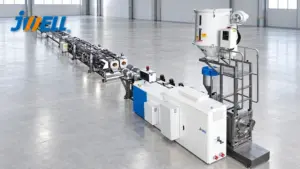
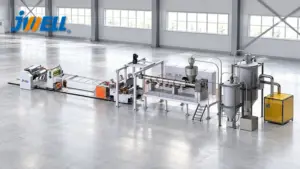
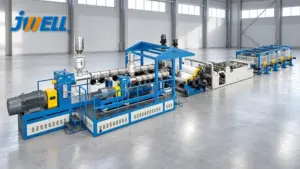
For a pellet-fed HDPE or PP drainage-pipe project, JWELL’s horizontal double-wall corrugated pipe extrusion line is worth shortlisting for its water-cooled, quick-release forming modules. If the project involves direct powder/granule feeding and online filler dosing, the twin-screw arrangement described for JWELL’s vertical-type line is worth investigating. These are differences between the quoted configurations, not inherent rules about every horizontal or vertical machine.
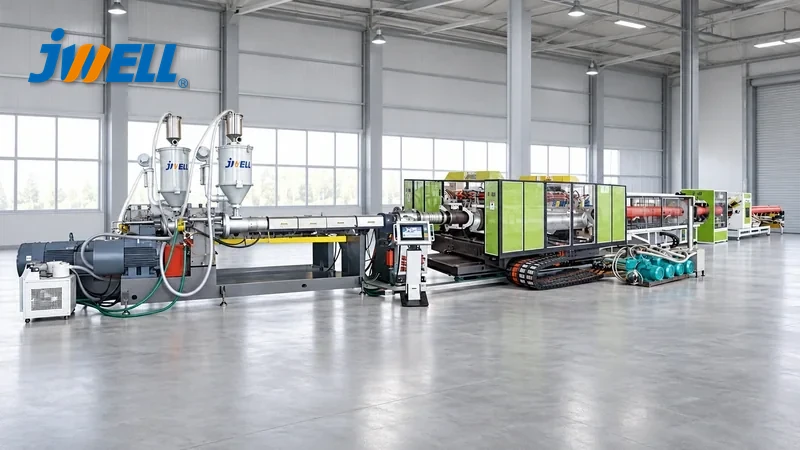
For drainage pipe manufacturers, the better configuration is the one that consistently meets the required diameter, ring stiffness, joint dimensions and weight per meter using the intended resin recipe. A reliable comparison therefore starts with the finished pipe specification and an agreed production trial.
What do horizontal and vertical mean?
Here, horizontal and vertical refer to the corrugator and its mold-block arrangement. The pipe itself can travel horizontally in either configuration. A layout drawing should show how the blocks open, return and close around the forming section, as well as the space needed to remove them for maintenance.
Both systems must form a corrugated outer wall and a smooth inner liner, bond those layers and cool the structure sufficiently for downstream handling. Typical process stages include feeding, separate melt preparation for the two walls, a coextrusion die, corrugation, cooling, cutting and collection.
The JWELL horizontal double-wall corrugated pipe production line uses quick-release modules, internal module cooling and coordinated PLC control. For a producer changing pipe sizes regularly, the practical questions are how long a full tooling change takes and how much scrap is generated before acceptable pipe resumes.
<!–WPIMG:0–>
Compare configurations using the same specification
|
Item |
JWELL horizontal product description |
JWELL vertical-type product description |
|---|---|---|
|
Extrusion arrangement |
Lists paired JWS extruders; select screws for the intended resin |
Describes a parallel twin-screw arrangement with side feeding |
|
Material preparation |
Assess against the proposed pellet or compound feed |
Describes direct powder/granule feeding and filler adjustment |
|
Forming features highlighted |
Quick-release modules and internal module cooling |
Confirm block opening, cooling and return arrangement in the technical offer |
|
Maintenance questions |
Time to exchange modules and service cooling passages |
Access to screws, side feeders, vents and forming modules |
|
Purchase decision |
Test the main pipe sizes and the expected changeover schedule |
Test recipe consistency, feeding stability and the main pipe sizes |
Do not compare a pellet-fed single-screw quotation with a powder-compounding twin-screw quotation and attribute every difference to orientation. Extrusion, formulation handling and forming are separate design choices.
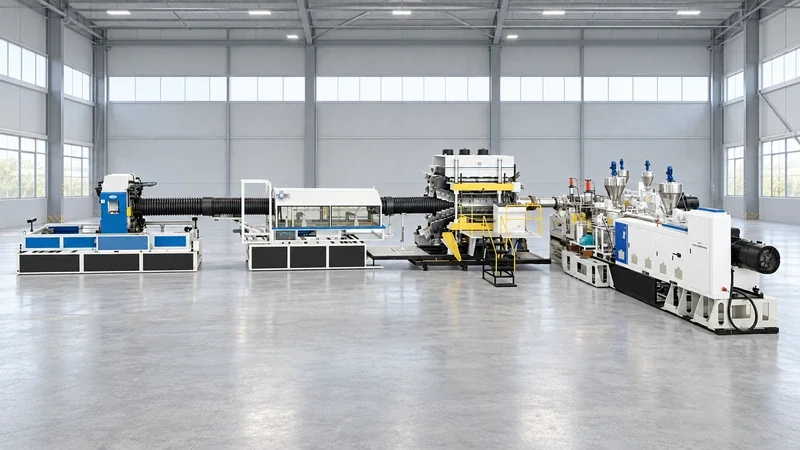
The JWELL vertical-type double-wall corrugated pipe line describes twin-screw extrusion, side feeding and vacuum venting. This arrangement addresses a different material-handling task from simply melting a ready-made compound. Specify the permitted filler content and pipe test requirements first; the lowest resin cost is useful only if the finished pipe meets them.
<!–WPIMG:1–>
Cooling determines usable production speed
A high extruder output does not automatically translate into a high pipe speed. The mold system must shape the outside profile, maintain the liner and remove enough heat before the pipe loses support. Insufficient cooling can cause deformation, inconsistent dimensions or damage during cutting and stacking.
Ask for cooling-water inlet temperature, required flow, pressure, water quality and total heat rejection at the intended production rate. A machine demonstrated with cold factory water may behave differently at a hot site with an undersized cooling tower.
Relate mass throughput to pipe speed using:
Line speed (m/min) = pipe mass throughput (kg/h) ÷ [60 × pipe mass (kg/m)].
For an illustrative pipe weighing 5 kg/m, 600 kg/h corresponds to 2 m/min before rejected lengths and downtime. This calculation is a mass balance, not a guaranteed operating point. It also assumes that all of the stated throughput becomes pipe rather than purge or other losses.
On a two-extruder line, each extruder must supply its assigned wall at a stable rate. A large combined output figure is little help if the inner-wall extruder reaches its limit first.
Tooling quality matters as much as machine orientation
Ring stiffness depends on polymer properties, corrugation geometry, material distribution and wall bonding. Increasing pipe weight may improve some test results, but it also increases resin consumption. Compare designs at the agreed minimum wall requirements and test conditions.
Inspect the liner for smoothness, thinning and local collapse. Check the crest and valley regions, the interface between the two walls and socket geometry where an inline socket is required. A pipe can have an acceptable average weight while still containing weak local sections.
Mold ownership is another purchasing issue. Establish how many diameter sets are included, whether socket blocks are separate, how replacement blocks are identified and how wear affects alignment. Request the handling procedure and storage requirements for a complete mold set.
For frequent product changes, record the time needed to stop, exchange tooling, heat or stabilize the process, adjust the recipe and produce the first accepted pipe. Mechanical block replacement is only one part of a changeover.
Calculate operating cost per accepted meter
Compare energy and labor against saleable output. Installed power is the sum of rated equipment loads, not measured running consumption; electrical supply sizing must also consider simultaneous demand and starting loads. Similarly, nameplate kilograms per hour do not account for startup losses, maintenance or customer rejections.
Use the following costing structure:
Conversion cost per accepted meter = total conversion cost during the period ÷ accepted meters produced.
Include electricity, cooling, compressed air, direct labor, maintenance consumables and reject handling within a clearly defined boundary. Track resin separately when evaluating conversion efficiency, then combine both figures for the complete manufacturing cost.
Factory layout can change the result. Space is required for extruder withdrawal, electrical cabinet access, mold transport, pipe collection and safe lifting. Request a drawing that includes service clearances and utility equipment instead of measuring only the machine envelope.
Specify a production acceptance trial
Provide both suppliers with the same resin grade, permitted recycled content, filler limits, diameter schedule and finished-pipe requirements. Set an agreed continuous running period and specify how startup scrap is recorded.
The trial record should include:
- Accepted meters per hour and measured kilograms per meter.
- Inner and outer dimensions, ovality and wall distribution.
- Ring stiffness and other tests required by the selected product specification.
- Joint and socket checks for the intended coupling system.
- Water conditions, measured electrical consumption and operator attendance.
- Changeover time, restart waste and alarms during the run.
Take samples across the run rather than selecting one visually attractive section. Agree which deviations require adjustment, retesting or corrective action before shipment. Retain the settings and sample identification as a baseline for commissioning at the buyer’s factory.
FAQ
Is a vertical line always more compact?
No. Compare the complete layout, including mold handling, service clearances, lifting height and downstream pipe storage. A smaller corrugator does not necessarily create a smaller installed plant.
Can one line process HDPE, PP and PVC?
Only with a configuration and tooling suitable for each material. Confirm the required extruders, screw designs, dies and process settings; a multi-material product title is not a complete technical specification.
Which line gives better ring stiffness?
Neither orientation guarantees it. Ring stiffness must be demonstrated with the intended resin, profile, pipe mass and test method.
Should buyers prioritize maximum speed?
Prioritize stable, accepted output across the intended product mix. Maximum speed on a light or easy-to-cool pipe may not represent the main commercial product.
Request a Quote for a JWELL Double-Wall Corrugated Pipe Extrusion Line
Buying a drainage-pipe production line? JWELL supplies horizontal and vertical-type double-wall corrugated pipe lines for different material and production requirements. Request an equipment quotation covering the extruders, die, corrugator, mold sets, cooling and cutting equipment needed for your pipe range.
Send your resin grade, diameters, ring-stiffness class, target pipe weight and hourly output to JWELL Anhui sales. Include your factory layout and cooling-water conditions so JWELL can specify the line configuration and tooling for your purchase.