Choose EVA for proven, cost-focused modules; POE for stronger moisture barrier, electrical insulation and PID resistance; and EPE for a balance of EVA adhesion and POE protection. In photovoltaics, EPE means coextruded EVA/POE/EVA, not expanded polyethylene foam. Always validate the encapsulant in the complete module stack.
What a PV Encapsulant Must Do
The encapsulant sits between the solar cells and the front glass and rear glass or backsheet. During vacuum lamination, it softens, flows around cells and interconnects, removes voids and—depending on formulation—crosslinks. In service, it must retain adhesion and transparency while protecting fragile electrical components through heat, humidity, ultraviolet exposure and mechanical stress.
Important purchase specifications include light transmittance, haze, volume resistivity, water-vapor transmission rate, adhesion after aging, gel content for crosslinking grades, shrinkage, thickness uniformity and lamination window. These properties belong to the complete formulation, not only the base polymer. Additives, stabilizers, coupling agents and curing chemistry can make two films of the same family perform differently.
EVA Solar Encapsulation Film
Ethylene-vinyl acetate has a long manufacturing history in crystalline-silicon modules. It offers good transparency, established glass adhesion, broad supply and familiar lamination behavior. Its process knowledge and cost position make it a practical choice for many conventional module designs.
EVA formulations commonly use peroxide crosslinking during lamination. Process control must ensure adequate cure without creating bubbles, excessive shrinkage or damage to cells. Gel content is often used as one indicator of crosslinking, but it should be evaluated alongside peel strength, optical performance and aging results.
The main reliability concern is that EVA can undergo degradation under heat, moisture and UV exposure. Its chemistry can generate acetic acid under degradation conditions, which may contribute to corrosion and interfacial problems. Modern stabilization packages and module designs mitigate risk, so material family alone should not be treated as a prediction of field life.
EVA is often suitable when: the module design is proven with EVA, cost and lamination productivity are priorities, and qualification data demonstrate acceptable damp-heat, UV, thermal-cycle and potential-induced-degradation performance.
POE Solar Encapsulation Film
Polyolefin elastomer encapsulants are valued for low moisture permeability, high electrical resistivity and resistance to acid-generating degradation associated with EVA chemistry. These characteristics make POE attractive for moisture-sensitive, high-voltage and advanced-cell module designs, including many glass-glass and bifacial products.
POE is not automatically drop-in compatible with an EVA process. It may have a narrower or different lamination window, different adhesion behavior and greater sensitivity to handling or formulation choices. Crosslinking POE and thermoplastic polyolefin products should also not be assumed identical.
POE film generally costs more than commodity EVA and can require careful control of surface treatment, storage, layup and lamination. Its value should be measured through module-level reliability and energy-yield risk, not resin price alone.
POE is often suitable when: moisture barrier and electrical insulation are high priorities; the module uses n-type, bifacial or other PID-sensitive architecture; and the manufacturer can qualify adhesion and lamination with the selected glass, cell and backsheet.
EPE Coextruded Solar Encapsulation Film
EPE uses EVA outer layers around a POE or polyolefin-based core. The concept places EVA at the bonding interfaces for familiar adhesion and lamination behavior while the inner polyolefin layer improves moisture barrier and electrical properties.
This hybrid can reduce cost compared with a full-thickness POE film and may be easier to integrate into an EVA-oriented module process. However, performance depends strongly on the layer ratio, core chemistry, interlayer compatibility and whether each layer crosslinks as intended. “EPE” is not one standardized formulation.
The multilayer structure also creates production requirements. Layer thickness must remain uniform across the web, the interfaces must be stable, and the winding process must avoid blocking or distortion. A visually acceptable roll can still have an incorrect core ratio, so gravimetric feeding and process traceability are important.
EPE is often suitable when: the module maker wants improved barrier and electrical performance without the full cost or process change of all-POE encapsulation, and has qualification data for the exact coextruded product.
EVA vs POE vs EPE: Practical Comparison
| Decision factor | EVA | POE | EPE (EVA/POE/EVA) |
| Commercial maturity | Very high | High and growing | High and growing |
| Relative material cost | Usually lowest | Usually highest | Often between EVA and POE |
| Moisture barrier | Moderate | Generally stronger | Better than EVA; depends on core and ratio |
| Electrical insulation/PID resistance | Formulation and module dependent | Generally a key strength | Designed to improve over EVA |
| Adhesion/process familiarity | Well established | Requires careful qualification | EVA skins can support familiar bonding |
| Manufacturing complexity | Single-layer process possible | Single-layer process possible | Requires precise coextrusion |
| Best use case | Proven mainstream designs | High-reliability and moisture-sensitive designs | Cost/performance bridge |
These are directional comparisons, not guaranteed values. Request data from the film supplier for the exact grade and test the complete module stack.
Match Encapsulant to Module Architecture
For a glass-backsheet module, the backsheet contributes moisture and electrical performance, so encapsulant selection must consider the pair. In glass-glass modules, edge ingress, cell chemistry and high system voltage can make encapsulant resistivity and barrier performance especially important. Bifacial modules also require strong optical performance on both sides.
Advanced n-type technologies, fine metallization and long service-life targets have increased attention to ionic movement, corrosion and PID. Yet switching polymer families without requalifying adhesion, cure and thermal stress can create new risks. Use a structured design-of-experiments approach rather than a single-property comparison.
Qualification Tests to Request
Review both incoming-film data and laminated-module results:
- Film thickness and transverse profile
- Optical transmittance, haze and yellowness index
- Volume resistivity and dielectric performance
- Water-vapor transmission rate under stated conditions
- Cure behavior and gel content where applicable
- Free shrinkage and dimensional stability
- Peel adhesion to the exact glass and backsheet after aging
- Damp heat, thermal cycling, humidity-freeze and UV exposure
- PID testing at the intended system polarity and voltage
- Electroluminescence inspection before and after lamination
- Cross-sectional checks for bubbles, voids and cell movement
Qualification should follow the standards and customer requirements of the destination market. Accelerated tests identify comparative risk, but they do not guarantee a specific field lifetime.
Production-Line Requirements for Consistent Film
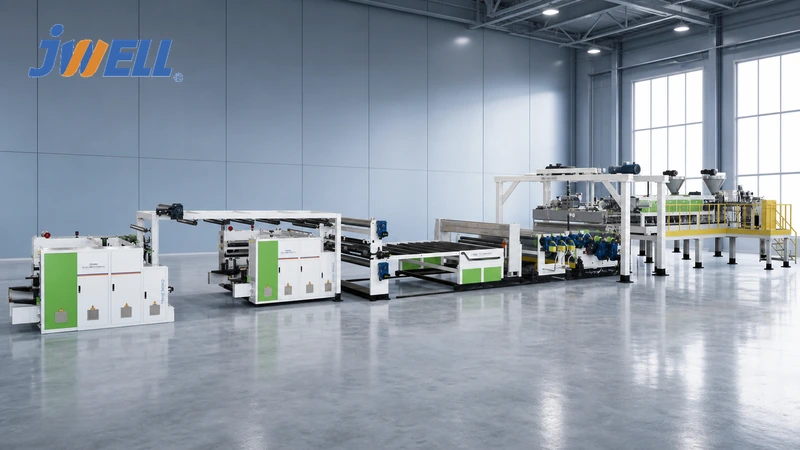
An encapsulant film line must deliver low thermal history, accurate dosing, stable melt temperature, uniform thickness, controlled surface texture and clean winding. For EPE, each extruder must hold the required layer ratio at the full width and speed range. Online gauging and closed-loop control help limit thickness variation, while filtration and clean material handling reduce gels and contamination.
Cooling-roll temperature and surface condition influence optical quality and shrinkage. Winding tension must prevent telescoping, blocking and deformation. Recipe management, traceability and online defect inspection become increasingly valuable for high-volume module supply.
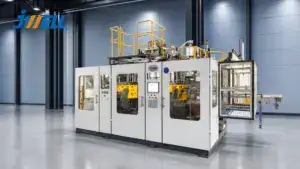
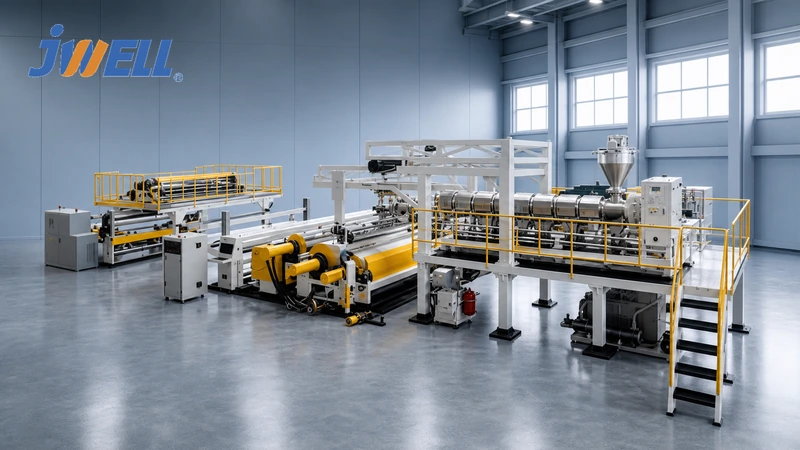
JWELL’s EVA/POE solar film extrusion line is intended for precision encapsulant-film production. Manufacturers considering broader interlayer applications can also review the EVA/POE/PVB/SGP film extrusion line.
Make the Decision With Module-Level Data
Choose EVA when a mature, cost-efficient stack has passed the required reliability tests. Choose POE when moisture barrier, resistivity and advanced-cell protection justify its cost and process requirements. Choose EPE when a validated EVA/POE/EVA structure provides the best balance of interface behavior, barrier performance and economics.
If you plan to manufacture one or more of these films, send JWELL the formulation family, layer structure, width, thickness, output, surface pattern, winding specification and quality protocol. Contact JWELL’s film extrusion team to develop a line configuration and trial plan around your target solar encapsulation film.