As a preliminary planning rule, allow about 300–500 m² for a small commercial extrusion line, 450–750 m² for a 500 kg/h class line, and 700–1,200 m² for a 1,000 kg/h class line once raw-material storage, finished goods, utilities and aisles are included. Installed electrical load commonly falls in the broad ranges of 150–250 kW, 250–450 kW and 450–750 kW respectively, while direct operating labor is often about 2–4, 3–5 and 5–8 people per shift.
These are budgeting ranges, not guarantees; the product, resin, downstream equipment, automation and local building code determine the final requirement.
Space: calculate the operating footprint, not just machine length
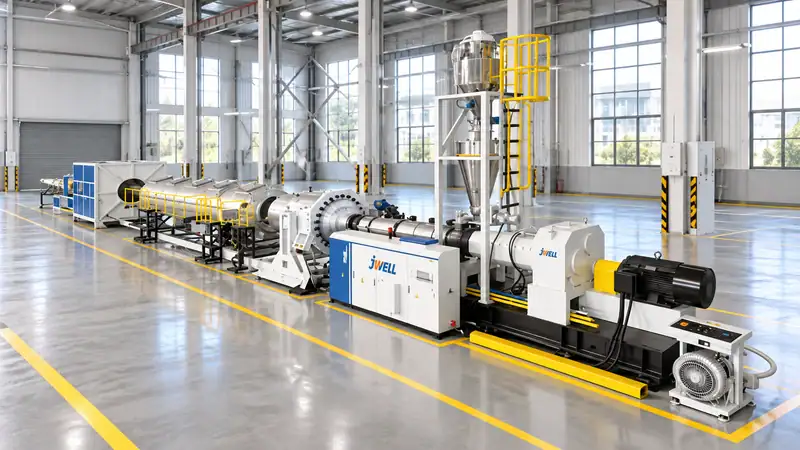
An extrusion line may occupy only a narrow rectangle, but a safe factory needs space around it. Include the extruder and die, calibration or cooling equipment, haul-off, cutter or winder, control cabinets, operator access, maintenance pull-out zones and product discharge. Then add material staging, finished-goods storage, quality inspection, packing, utilities and forklift aisles.
| Planning item | 300 kg/h class | 500 kg/h class | 1,000 kg/h class |
| Process-line zone | 120–200 m² | 180–300 m² | 280–500 m² |
| Utilities and maintenance allowance | 40–80 m² | 60–120 m² | 100–180 m² |
| Material, packing and aisle allowance | 140–220 m² | 210–330 m² | 320–520 m² |
| Practical total starting allowance | 300–500 m² | 450–750 m² | 700–1,200 m² |
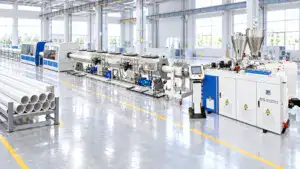
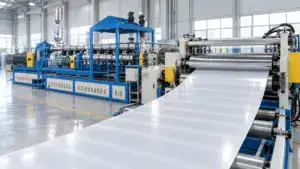
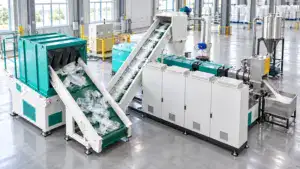
Long pipe lines need a straight path and enough clearance at the haul-off and cutting end. Sheet and profile lines need room for stacking, edge trimming or winding. Pelletizing lines need space for silos, bagging and dust collection. Ask the supplier for a dimensioned general-arrangement drawing in both metric and local fire-escape conventions.
Building height, floor loading and movement
Check clear height before approving a building. Hopper loaders, silos, bag filters, lifting beams and overhead ducting may be taller than the extruder itself. Provide a lifting route for screws, barrels, dies, chillers and gearboxes. Floor loading must account for the machine frame, full hoppers, water tanks, silos and forklifts; do not rely on a generic “industrial floor” label.
Separate pedestrian and forklift movement. Keep resin receiving away from clean finished-goods storage, and reserve a quarantine area for material awaiting quality release. A small amount of planned empty space often prevents major losses later when a second feeder, a larger chiller or a new packing machine is added.
Power: distinguish connected load from actual consumption
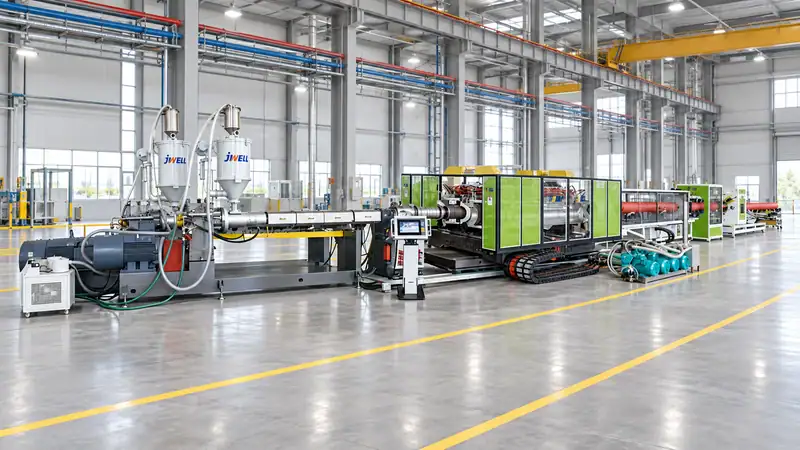
The supplier’s installed or connected load is the sum of motors, heaters, pumps, fans, chillers, dryers, conveyors and controls. The factory’s actual demand is lower and changes with product and duty cycle. A utility study should include:
- extruder motor rating and drive efficiency;
- barrel, die and adapter heater zones;
- vacuum pumps, cooling pumps and chillers;
- haul-off, cutter, winder or pelletizer motors;
- dryers, material loaders and dust collection;
- lighting, HVAC, laboratory and compressed air;
- starting current, power factor and transformer margin.
For preliminary budgeting, an extrusion machine in the 300 kg/h class may require 150–250 kW connected load; a 500 kg/h class line may require 250–450 kW; and a 1,000 kg/h class line may require 450–750 kW. Specific energy use is better expressed as kWh per saleable kilogram. It varies with resin, output, temperature, screw design, cooling demand and utilization. Request both maximum connected load and expected operating load at your target product rate.
Do not size the transformer exactly to the nameplate. Coordinate with the electrical engineer on demand factor, spare capacity, harmonics, emergency shutdown and local utility requirements. A generator or backup system may keep controls and cooling safe, but it may not be sized to run the entire heating and drive load.
Water, compressed air and drainage
Pipe, profile and sheet lines often need continuous cooling water. Include the chiller, pump, tank, filtration, heat rejection and water-treatment requirements. Closed-loop water reduces consumption but still needs make-up water and periodic cleaning. Provide floor drains and spill containment without routing dirty process water into a clean storm-water system.
Compressed air is used for valves, cutters, actuators and cleaning. Specify pressure, flow, dew point and oil-free requirements rather than only installing a compressor with a large horsepower label. A receiver and ring main can stabilize pressure when several machines cycle together.
Labor: count roles, not only operators
Direct staffing depends on automation, product complexity and the number of shifts. A practical starting range per shift is:
| Line size | Direct operating team per shift | Typical roles |
| 300 kg/h class | 2–4 | Line operator, material/packing operator, shared helper |
| 500 kg/h class | 3–5 | Lead operator, downstream operator, material/packing operator, shared helper |
| 1,000 kg/h class | 5–8 | Extruder operator, downstream operators, material team, packing and quality support |
These figures exclude maintenance, engineering, warehouse management and supervisors shared across shifts. A highly automated line may need fewer people at steady state but still needs trained coverage for startup, grade changes, screen changes, alarms and quality checks.
Layout for safe and stable production
Put the control cabinet where the operator can see critical zones without standing in a traffic lane. Keep hot surfaces guarded and provide lockout/tagout access. Make screen changers, knives, dies, filters and vacuum pumps serviceable without dismantling unrelated equipment. Provide a sample point for dimensional and melt-quality checks near the line, not only in a remote laboratory.
Material flow should be one-directional: receiving, quarantine, drying or blending, feeding, extrusion, downstream forming, inspection, packing and finished-goods release. Cross-traffic increases mix-ups and forklift risk. Mark utilities, emergency stops, fire equipment and chemical areas before commissioning.
A simple pre-order checklist
Before signing a purchase order, create a one-page utility and layout brief containing product dimensions, resin grades, maximum and normal output, working hours, building dimensions, transformer capacity, cooling-water temperature, compressed-air data, staffing plan and expansion assumptions. Send it to the equipment supplier and your local engineering contractor.
The best factory plan leaves room for maintenance and future changes. A line that fits on paper but has no access to remove a screw, no place to store resin and no transformer margin will cost more than the extra square meters planned at the beginning.
Before finalizing a building lease or transformer order, ask Jwell Anhui for a dimensioned layout and utility schedule tied to your exact product, output and automation level.
Plan your extrusion factory with Jwell
Before signing a lease or ordering a transformer, send your product dimensions, target throughput, resin grades and building drawings to Jwell Anhui. Our engineers can prepare a line layout, utility schedule and staffing recommendation for your specific pipe extrusion line project.
FAQ
Do these space figures include warehouses?
They include a modest allowance for material, packing and aisles, but not a large finished-goods warehouse or a high-bay raw-material store.
How can I reduce power demand?
Improve utilization, use efficient drives and heaters, recover heat where practical, control cooling water and avoid running oversized equipment at low load.
Can one operator run a complete line?
Sometimes at steady state, but safe staffing must cover startup, quality checks, material handling, changeovers and emergencies.
What information should I request from a supplier?
Ask for a general-arrangement drawing, connected load, expected kWh/kg, water and air requirements, noise data, maintenance clearances and a staffing recommendation based on your product mix.