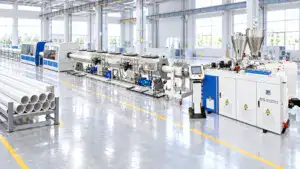
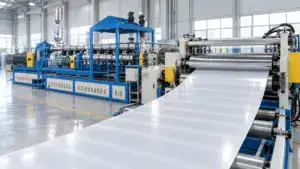
A corrugated pipe extrusion line is a specialized manufacturing system. It produces plastic pipes with a ribbed outer surface. The result is a simultaneously lightweight, structurally strong, and highly flexible pipe.
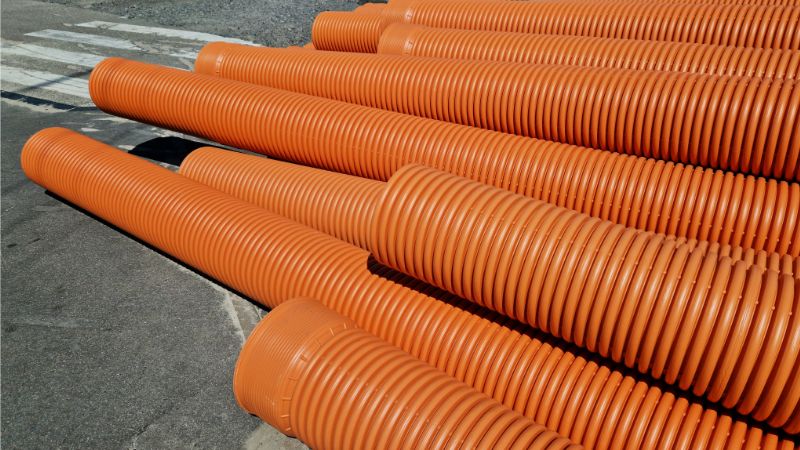
What Is a Corrugated Pipe Extrusion Line?
A corrugated pipe extrusion line is a continuous production system. It transforms plastic pellets into ribbed pipes through a coordinated sequence of melting, shaping, corrugating, cooling, and cutting. The corrugated profile is not simply cosmetic. The ribbed geometry dramatically increases ring stiffness. It also reduces the volume of raw material required and yields a pipe that outperforms solid-wall alternatives at a lower production cost.
Single-Wall vs. Double-Wall Lines
Single-wall lines produce pipes corrugated on both the inner and outer surfaces. These pipes are lightweight and flexible, ideal for cable protection conduits and light-duty drainage applications. The equipment setup is simpler, and changeovers are comparatively straightforward.
Double-wall lines are the more advanced configuration. They produce pipes with a corrugated outer wall bonded to a smooth inner wall, combining structural rigidity with low-friction flow performance. Because this design requires two extruders working in tandem to co-extrude and fuse the two layers simultaneously, double-wall lines are more complex and carry a higher capital cost.
Materials Used in Production
The three most common materials processed on corrugated pipe extrusion lines are HDPE (High-Density Polyethylene), PP (Polypropylene), and PVC (Polyvinyl Chloride). Each has distinct processing characteristics and performance advantages.
HDPE is the industry standard for most drainage and sewage applications. It offers excellent chemical resistance, maintains flexibility in sub-zero temperatures, and processes reliably at melt temperatures of 170–230°C. PP delivers better heat resistance and is favored in industrial environments with elevated temperatures. PVC, less common on modern lines, remains in use for certain legacy infrastructure and specific regional markets.
Main Components of a Corrugated Pipe Extrusion Machine
A complete corrugated pipe extrusion line integrates several critical subsystems. Each component plays a defined role in determining the final pipe’s quality, dimensional accuracy, and production efficiency.
1. Raw Material Feeding System
2. Single-Screw Extruder
3. Extrusion Die
4. Corrugator (Forming Machine)
5. Cooling Systems
6. Haul-Off Unit
7. Cutting and Winding/Stacking
8. PLC Control System
Key Process Parameters of High Efficiency
The table below summarizes the critical process parameters for corrugated pipe extrusion and their effect on pipe quality in the production line.
| Parameter | Typical Range | Effect on Pipe Quality |
|---|---|---|
| Melt temperature | 170–230°C | Affects surface finish, flow consistency, and mechanical strength |
| Vacuum pressure | −0.03 to −0.08 MPa | Determines corrugation depth and dimensional accuracy |
| Cooling water temperature | 10–25°C | Controls dimensional stability and residual stress |
| Line speed | 1–10 m/min | Affects corrugation accuracy and output rate |
| Pipe diameter range | 40–1200 mm | Defines the application scope of the line |
The Production Process: Step by Step
Stage 1 — Material Preparation and Melting
Raw plastic pellets are loaded into the hopper and fed into the extruder barrel. The rotating screw progressively heats and shears the material through multiple heated zones. It creates a homogeneous melt by the time the plastic reaches the die. Temperature control at this stage is critical: too high and the polymer degrades; too low and the melt viscosity is too high for proper forming.
Stage 2 — Pipe Extrusion
The molten plastic exits through the die as a smooth, circular tube. In double-wall production, two melt streams exit a co-extrusion die simultaneously, with the outer layer positioned to receive corrugation and the inner layer designed to remain smooth.
Stage 3 — Corrugation Forming
The soft tube enters the corrugator immediately after the die. Vacuum pressure pulls the wall into the mold block cavities while the blocks travel at a speed precisely matched to the extrusion rate. This is where the characteristic ribbed profile is created, and where the line demands the most precise process control.
Stage 4 — Cooling and Sizing
Water cooling rapidly solidifies the corrugated profile. For double-wall pipes, sizing tools may be used to maintain the correct outer diameter while the inner wall cools and bonds with the outer layer. Consistent cooling temperature and water flow rate are vital to achieving dimensional compliance across the full production run.
Stage 5 — Cutting and Downstream Handling
The cooled pipe passes through the haul-off unit and enters the cutting station, where it is divided into specified lengths. Flexible, small-diameter pipes are wound onto coils; rigid, large-diameter double-wall corrugated pipes are stacked for dispatch.
Applications of Corrugated Pipes
Corrugated pipes are used across a wide range of infrastructure and construction applications:
- Underground drainage — rainwater management, road drainage, and parking lot runoff systems
- Sewage and wastewater — gravity-fed sewer mains and lateral connections
- Cable and wire protection — conduits protecting electrical, telecommunications, and fiber optic cables
- Agricultural drainage and irrigation — subsurface field drainage and water distribution
- Highway and rail infrastructure — culverts beneath roads and rail embankments
Pipe diameter selection depends on the application: small-bore pipes from 40mm serve cable protection and minor drainage, while large-diameter pipes up to 1200mm handle major sewer and stormwater infrastructure.
Common Challenges and How to Address Them
Irregular corrugation geometry is typically caused by unstable melt temperature, insufficient vacuum, or worn and misaligned mold blocks. The solution is to stabilize temperature control zones, audit vacuum system seals regularly, and maintain mold block alignment and cleanliness.
Uneven wall thickness most often stems from a poorly balanced die, fluctuating extruder output pressure, or inconsistent raw material quality. Precision die design and stable extruder operation are the primary preventive measures.
Surface roughness or defects can result from contaminated material, degraded polymer from overheating, or inadequate cooling. Proper material drying before processing, accurate temperature profiling, and sufficient cooling capacity are essential. These steps address most surface quality problems.
Choosing the Right Corrugated Pipe Extrusion Line
The pipe diameter range and wall type (single or double wall) should be matched to your target product mix. The extruder screw design and L/D ratio must be optimized for your chosen resin. The mold block system should offer rapid changeover capability and consistently precise corrugation geometry, with wear-resistant surface treatments for extended service life.
Vacuum and cooling system performance directly determines forming accuracy — look for consistent vacuum pressure control and efficient water circulation. Automation level matters for reducing operator dependence and achieving process consistency; modern lines with full PLC integration, online measurement, and data logging deliver better quality and productivity.
Quality Control in Corrugated Pipe Production
Consistent quality requires systematic testing throughout production. Ring stiffness testing verifies that pipes can withstand soil loads and external pressure. Impact resistance testing confirms the pipe won’t crack under installation stress or thermal cycling in compliance with the manufacturer’s specifications. Dimensional measurement — wall thickness, outer diameter, and corrugation depth — must be checked at regular intervals.
Upgrade Your Corrugated Pipe Extrusion with Jwell
Frequently Asked Questions
What does the corrugator do?
The corrugator uses two continuously moving chains of mold blocks and vacuum pressure (typically −0.03 to −0.08 MPa) to pull the soft, freshly extruded tube into a ribbed shape while the plastic is still formable.
Why is corrugated pipe stronger than smooth pipe of the same weight?
The ribbed geometry increases ring stiffness — the pipe’s resistance to deformation under external loads — without adding material. This structural efficiency is why corrugated pipes are preferred for buried applications.
What causes uneven corrugations during production?
The most common causes are a mismatch between extrusion speed and corrugator speed, insufficient or unstable vacuum pressure, worn or misaligned mold blocks, and inconsistent melt temperature from the extruder.
What diameters can a corrugated pipe extrusion line produce?
Most lines are configured to cover a specific diameter range. Standard ranges span from 40mm up to 1200mm, with the line configuration, extruder size, and corrugator design selected to match the target product range.
How important is the PLC control system?
Critical. The PLC coordinates all production parameters in real time: extruder temperature, vacuum pressure, line speed, and cooling. Modern systems add automated defect detection and data logging, which directly supports both consistent quality and product traceability.