The fastest way to reduce waste in plastic pipe extrusion is to control the process before scrap is created: stabilize feeding and melt temperature, shorten startup and changeover time, measure dimensions continuously, and segregate any regrind that is allowed by the product standard. Track waste as kilograms per saleable kilogram by cause—not as one monthly total—so the team can fix the largest loss first.

Where pipe-extrusion waste comes from
Most material loss falls into six categories:
- Startup and shutdown scrap:material produced while temperature, pressure, cooling and haul-off speed are stabilizing.
- Dimensional rejects:wall thickness, outside diameter, ovality or length outside specification.
- Surface and appearance defects:melt fracture, die lines, black specks, bubbles, splay or discoloration.
- Changeover loss:purging, color changes, resin changes and die or tooling adjustments.
- Downstream trim:cut ends, bell or socket trimming, drilling and handling damage.
- Contaminated or unapproved regrind:material that cannot be safely returned to the recipe.
Measure each category separately. A line can show a lower total waste rate while startup scrap is rising if another product is temporarily producing fewer trims. Cause-based data prevents false improvement.
1. Stabilize material feeding
Consistent feeding is the foundation of consistent pipe. Use gravimetric dosing where recipe accuracy, multiple additives or frequent product changes justify it. Verify feeder calibration at the actual material bulk density, not only with a factory test material. Keep resin dry when required, protect open bags from humidity and avoid bridging in hoppers.
For PVC, stabilizer, impact modifier, filler and lubricant balance affects fusion and surface quality. For polyolefin pipe, moisture, contamination and additive dispersion influence melt strength and dimensions. Store each component with a lot number and use a controlled recipe so operators do not correct a process problem by adding unrecorded material.
2. Control the melt before the die
Extruder temperature zones should be treated as a process profile, not a set of independent heater numbers. Monitor melt temperature and pressure near the adapter or die. A pressure trend that slowly rises may indicate screen contamination, moisture, degraded material or a feeding problem.
Use a suitable screen changer and define a pressure limit that triggers inspection. Excessive residence time and high temperature can create black specks and degrade sensitive polymers. Insufficient temperature or mixing can create unmelted particles and weak fusion. The goal is a stable melt at the lowest temperature that achieves the required dispersion and surface quality.
3. Shorten startup without rushing it
Prepare the recipe, tooling, cooling water, haul-off and inspection equipment before feeding polymer. A standardized startup sequence should specify heat-up confirmation, screw-speed steps, die centering, vacuum level, cooling temperature, haul-off synchronization and the first acceptable measurement.
Use a startup checklist with target ranges rather than relying on one experienced operator. Capture the kilograms used before the first good pipe and the minutes from first melt to quality release. If startup loss is high, review whether the cause is thermal stabilization, die adjustment, vacuum calibration, downstream timing or inspection delay.
4. Keep dimensions stable downstream
The calibration sleeve, vacuum tank, cooling system, haul-off and cutter work as one system. Uneven water temperature or flow can cause ovality and wall-thickness variation. Haul-off slip or speed fluctuation changes wall thickness even when the extruder rate is constant. Worn belts, rollers and seals should be treated as process risks, not only maintenance issues.
Online diameter, wall-thickness or laser inspection can detect drift before an entire coil or bundle becomes nonconforming. Connect alarms to a clear response plan: slow the line, adjust centering, inspect cooling, check pressure or stop and quarantine. Measurement is valuable only when the operator knows what action each alarm requires.
5. Reduce changeover and purge losses
Group products by resin family, color and diameter so the schedule minimizes difficult transitions. Run light colors before dark colors when practical. Prepare the next die, calibration tooling, recipe and packaging while the current order is running. Separate planned purge material from contaminated or unknown material.
The right purge method depends on the polymer and machine. Mechanical cleaning, approved purge compounds and controlled speed changes each have a place. Avoid aggressive shortcuts that damage screws, barrels or dies. Record kilograms and minutes per changeover; a small improvement repeated every day can exceed the benefit of a one-time equipment upgrade.
6. Use regrind according to the specification
Regrind can reduce virgin-material consumption, but it is not automatically suitable for every pipe. Pressure pipe, potable-water pipe and other regulated products may limit or prohibit internal regrind, or may require validated formulation and traceability. Never blend regrind into a critical product simply to reduce a waste KPI.
Segregate regrind by polymer, color, product grade and contamination status. Keep clean startup pieces separate from floor sweepings and mixed-material scrap. Measure regrind moisture, bulk density and particle size if these variables affect feeding. Define a maximum percentage in the recipe and verify mechanical, dimensional and long-term performance.
7. Prevent defects with preventive maintenance
Worn dies, calibration sleeves, vacuum seals, haul-off belts, cutters and temperature sensors create recurring scrap. Build a maintenance plan around failure modes: inspect die lips for buildup, check calibration tooling for wear, verify sensor calibration and record screen-change pressure. A small leak in the vacuum tank or a drifting thermocouple can create hours of unstable production.
Spare parts should be linked to the waste causes that stop production: heaters, thermocouples, sensors, seals, cutter blades, belts, screens and critical valves. Keep change parts clean and labeled so a rushed changeover does not introduce contamination.
8. Track the right KPIs
Use a daily dashboard with:
- Total waste rate:waste kg ÷ input kg × 100.
- First-pass yield:saleable kg ÷ input kg × 100.
- Startup scrap per order:startup kg ÷ order kg.
- Changeover loss:purge and transition kg per changeover.
- Dimensional reject rate:rejected kg caused by dimensions ÷ input kg.
- Energy intensity:kWh ÷ saleable kg.
Review the numbers by product, shift, operator, resin lot and tooling set. A Pareto chart normally identifies one or two dominant causes. Set a baseline for four weeks before changing several variables at once.
A practical 30-day improvement plan
In week one, weigh every waste category and verify scales. In week two, standardize startup and dimensional-check sheets. In week three, tune feeding, cooling and haul-off stability on the highest-volume SKU. In week four, review regrind rules, changeover sequence and preventive-maintenance findings. Repeat the measurement cycle and calculate the financial value of each improvement.
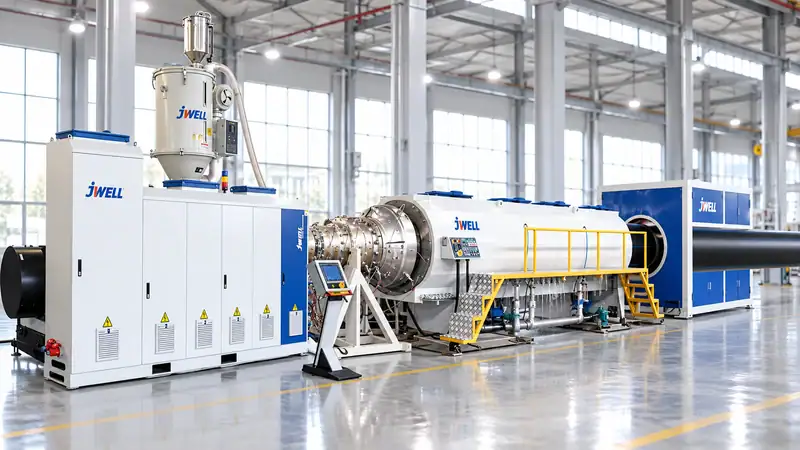
When evaluating a new plastic pipe extrusion line, ask the supplier how the design supports waste reduction: gravimetric dosing, melt-pressure monitoring, automatic temperature control, stable vacuum calibration, online dimensional inspection, quick tooling changes and data logging. The most useful answer will include expected startup kilograms, steady-state yield, measurement accuracy and the conditions behind those figures.
Jwell Anhui can review your current scrap data or product specification and propose a pipe-extrusion configuration with measurable yield and quality targets.
Get a waste-reduction review for your pipe line
Send your current scrap breakdown, pipe materials, diameter range and target output through the Jwell contact page. We can recommend process controls and a plastic pipe extrusion line configured for stable dimensions, lower startup scrap and measurable yield improvement.
FAQ
Is all startup scrap recyclable?
Not necessarily. It may be recyclable only when it is clean, identified and permitted by the product specification.
What is a good waste target?
It depends on polymer, pipe standard, diameter range and changeover frequency. Establish a measured baseline and improve the largest cause rather than copying a generic percentage.
Does gravimetric dosing eliminate waste?
No. It improves recipe consistency and can reduce variation, but die condition, cooling, haul-off and operator response still matter.
Should I slow the line to reduce rejects?
Sometimes, but lower speed is not always the lowest-cost solution. Compare scrap kilograms, energy per kilogram, labor and throughput at each stable operating point.